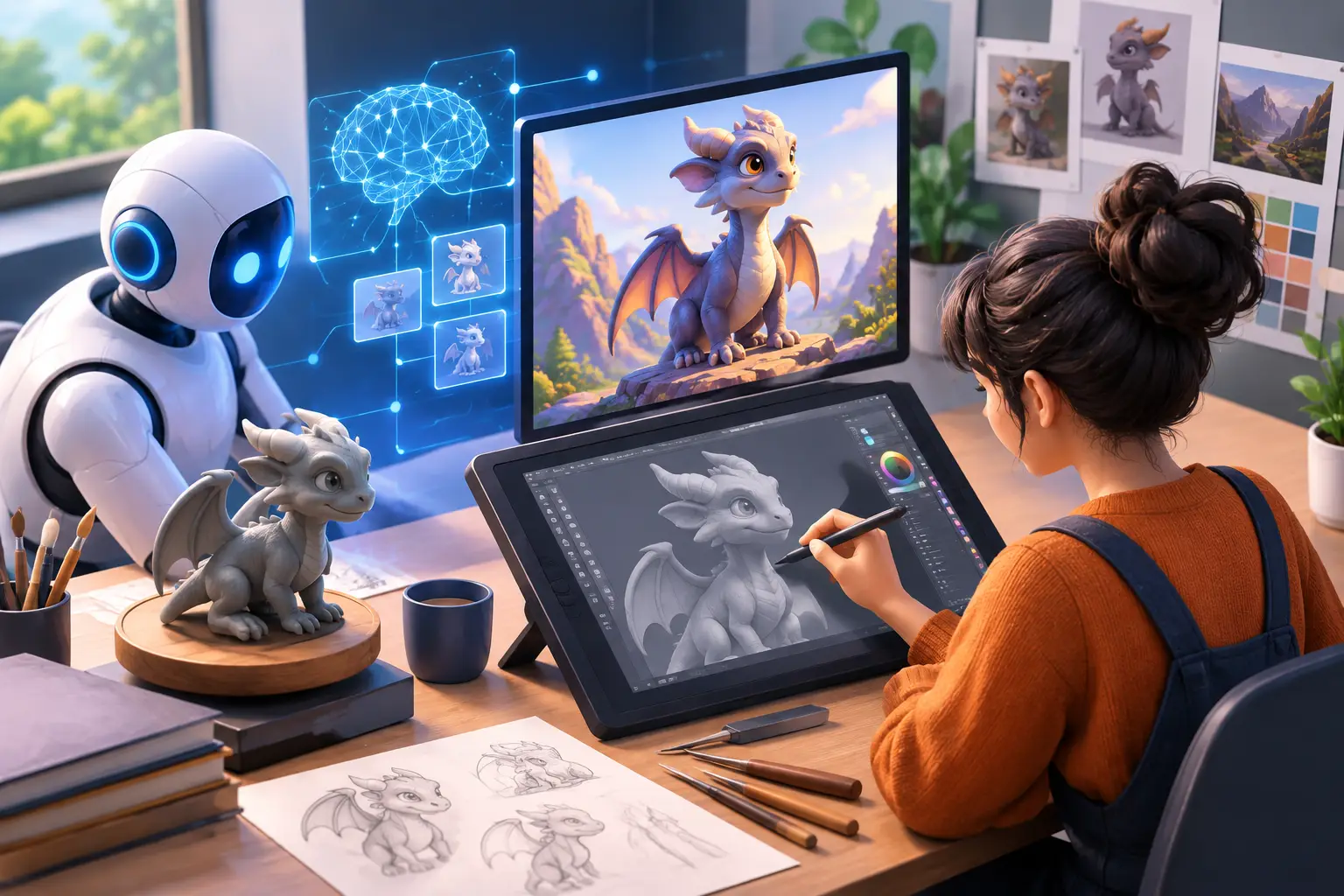
A product image can now appear in front of a creative team within minutes. That does not mean it is ready to represent a brand. In high-value campaigns, AI and CGI production are not interchangeable shortcuts. They are distinct capabilities that can work together, provided the process remains led by taste, technical judgement and exacting art direction.
For marketing teams under pressure to produce more content across more channels, artificial intelligence offers obvious appeal: faster exploration, broader visual references and early routes into concepts that might otherwise take days to articulate. CGI brings something different. It creates controllable, repeatable and brand-specific visual worlds, built to hold up at any scale, from a social crop to a flagship film.
The question is not whether AI has a role in commercial image-making. It does. The real question is where it adds value, where it introduces risk, and where distinguished artists remain essential.
Where AI and CGI Production Meet
AI is particularly useful at the beginning of a production. It can help turn loose language into visual territory, test compositional directions, suggest material contrasts or make an abstract campaign thought easier to discuss. For a creative director, that can make the first conversation more productive. A team arrives with a clearer sense of atmosphere, energy and potential narrative.
But exploratory imagery is not a production asset. It may imply impossible geometry, inconsistent lighting, unstable product details or visual references that cannot be safely or faithfully reproduced. Its apparent speed can also disguise a later cost: time spent correcting decisions that were never technically resolved in the first place.
CGI is where the image becomes intentional. A skilled artist can build the product accurately, establish the camera and lens behaviour, control every reflection, and shape light around the needs of the campaign. They can ensure that packaging retains its correct proportions, a medical device is represented responsibly, or a trainer has precisely the intended texture and construction. Those details are not incidental. They are often the difference between a compelling image and one that quietly weakens trust.
The strongest approach treats AI as a creative instrument, not an autonomous author. It informs ideation and previsualisation; CGI delivers the authored, approved and production-ready result.
The Difference Between Fast Images and Finished Work
Commercial visual production is judged on more than its first impression. Images must serve a brief, sit within a brand system and often perform across a family of executions. A hero visual may need to become a six-second animation, a vertical social asset, a retailer display, a web banner and packaging artwork. Consistency is not a cosmetic concern. It is operational.
CGI is uniquely valuable here because the underlying scene can be retained and refined. Once a product, environment or character has been built, the team can revisit the camera, adjust the colour palette, create regional variants or produce a new crop without restarting from zero. This is especially powerful for product launches with evolving specifications or campaigns requiring multiple market adaptations.
Generative tools can create a striking standalone frame, but they do not automatically provide that level of control. Maintaining an exact product silhouette across ten views, matching a tightly defined brand colour or generating a sequence with genuine continuity remains difficult without substantial artist intervention. The more precise the requirement, the less sensible it is to remove the specialist from the process.
That does not make CGI slow by default. It makes it deliberate. Efficient CGI production begins with clear references, agreed priorities and a realistic understanding of what must be built versus what can be suggested. It is possible to move quickly without treating quality assurance as optional.
Why Art Direction Matters More Than the Tool
A tool has no instinct for a brand’s visual equity. It does not understand why a food campaign should feel tactile rather than glossy, why a pharmaceutical image needs calm clarity instead of spectacle, or why a technology launch must signal precision without becoming cold. Those choices are made through art direction.
The most accomplished CGI artists bring traditional visual disciplines to digital production: composition, form, proportion, colour theory, photography and storytelling. Technology expands what they can make, but it does not replace the judgement behind each decision. A technically impressive render can still feel generic if it lacks a point of view.
This is where a curated talent network has a genuine advantage. A character specialist will approach gesture, personality and surface differently from an artist renowned for liquid simulations or architectural precision. The right appointment is not simply the person with the most impressive reel. It is the artist whose visual language is suited to the brief, and whose working practice can meet its demands.
For clients, that means asking a more useful question than, “Can AI make this?” Ask, “What level of authorship does this image require?” A rapid internal concept and an international launch campaign may share an initial prompt, but they should not share the same production standard.
The Risks That Deserve Boardroom Attention
The excitement around generative AI can make its limitations feel like minor technicalities. For commercial commissioners, they are not. Questions of provenance, usage rights, confidentiality and product accuracy should be addressed before visual development begins, not when a campaign is about to go live.
A brand should understand what information is being entered into any AI system, whether that material is permitted to leave the organisation, and how generated references will be used within the final workflow. Sensitive unreleased products, clinical claims and proprietary design details require particular care. The same is true of work featuring recognisable people, trademarks or distinctive competitor cues.
There is also a reputational issue. Audiences are increasingly alert to images that feel synthetic in the least flattering sense: over-polished, physically implausible or emotionally empty. This is not a reason to avoid innovation. It is a reason to apply it with discipline. The work should feel considered because it is considered.
A managed production partner can bring clarity to these decisions by setting the creative route, defining approval stages and keeping technical execution visible. Transparent communication is not separate from premium craft. It is what protects it when multiple stakeholders, markets and deliverables are involved.
A Better Production Model for Ambitious Brands
The most effective workflows tend to begin with a focused brief. Establish the commercial objective, the audience, the non-negotiable brand elements and the formats the work must serve. If AI-generated references are used, identify them clearly as exploratory material. Their purpose is to accelerate the conversation, not to quietly become the final standard.
From there, a CGI-led process can translate the chosen direction into a structured build. The team determines what needs to be modelled, what can be simulated, what should be composited and where practical photography might still be the strongest choice. There is no prize for making every element digital. The right solution is the one that gives the client the required control, quality and value.
At key stages, reviews should assess more than whether an image is attractive. Does the product feel true to life? Is the lighting communicating the intended mood? Will the composition work in every required format? Are motion, material and scale convincing? These are the checks that prevent an impressive early render becoming an expensive late-stage correction.
For animation, planning matters even more. AI can help visualise a tone or an opening beat, but movement needs rhythm, continuity and purpose. A premium CGI animation is choreographed shot by shot, whether it is a floating cosmetics film, a high-energy sports sequence or an intricate technical explainer. Motion should reveal the idea, not merely decorate it.
Craft Creates the Competitive Difference
There will be more images in circulation, not fewer. As generative tools become commonplace, visual abundance will cease to be a differentiator. Distinction will come from ideas with a recognisable point of view, products depicted with conviction and execution refined enough to reward attention.
That is why the future of AI and CGI production belongs neither to automation alone nor to nostalgia for older methods. It belongs to teams that know when to use speed, when to insist on precision and when to place the work in the hands of an artist with the mastery to make it memorable.
For brands commissioning their next campaign, the useful starting point is simple: use AI to broaden the conversation, then use expert CGI production to make the chosen idea unmistakably yours.