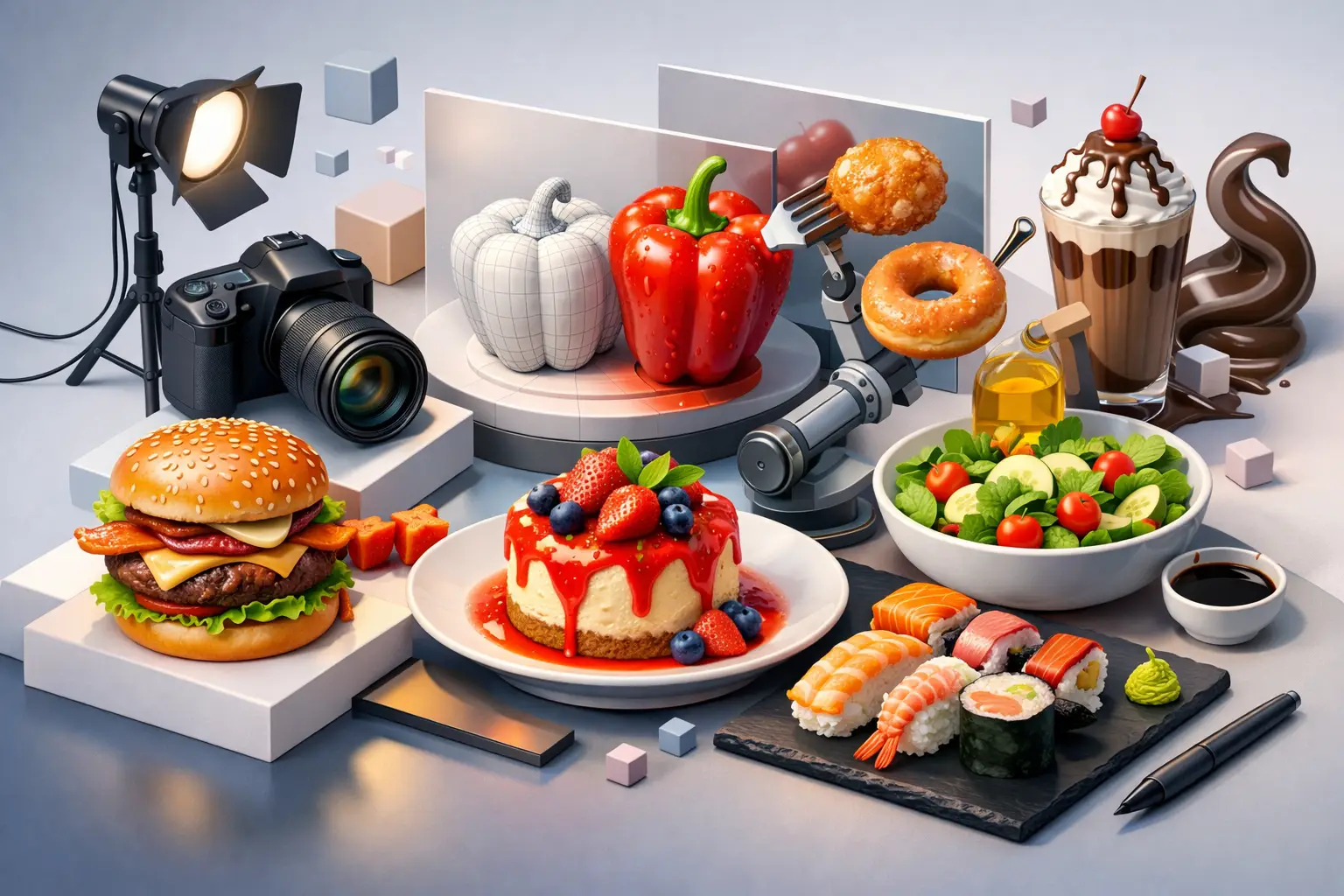
A sauce should cling at precisely the right moment. A biscuit should break with a believable crumb. Ice should remain flawless under the lights, even when the shot calls for a slow, lingering camera move. CGI food advertising gives brands control over these decisive details, creating imagery that is not merely appetising, but unmistakably intentional.
For food and beverage brands competing in crowded categories, visual quality is not a finishing touch. It is a commercial signal. The work has to establish taste, texture, provenance and premium value in seconds, whether it appears on a six-sheet poster, a retailer product page, social film or packaging artwork. High-end CGI makes that level of consistency possible while opening creative territory that conventional photography can struggle to reach.
Why food imagery demands more than a beautiful photograph
Traditional food photography remains a valuable discipline. It brings spontaneity, human craft and a particular kind of sensory realism. Yet it also comes with practical limits. Perishable ingredients change under studio lights, products may not be available during pre-production, and a hero shot designed for one campaign format can be difficult or expensive to recreate for another.
CGI changes the production equation. A digital product asset can be refined before the camera begins to move. The gloss level of chocolate, the translucency of a drink, the distribution of salt crystals and the density of steam can all be art directed with unusual precision. This does not mean making food look artificially perfect. The more sophisticated objective is to create a controlled version of reality that feels desirable, credible and true to the brand.
That distinction matters. Consumers have become highly attuned to imagery that feels generic or overly polished. The strongest work is grounded in close observation: how a toasted edge darkens, how condensation behaves on a chilled can, how light travels through a poured liquid. CGI is at its most convincing when distinguished artists apply traditional still-life principles alongside technical mastery.
CGI food advertising creates freedom at campaign scale
A successful food campaign rarely ends with one hero visual. It may require cut-down motion assets, retailer crops, seasonal versions, out-of-home executions, packaging adaptations and content for several markets. Building a campaign around photographed material can mean repeated shoots and limited flexibility once the set is struck.
With CGI food advertising, the core asset is built for adaptation. A single precisely modelled product can be placed within multiple environments, viewed from new angles or animated for different channels without sacrificing visual continuity. A launch film can share the same product geometry, materials and lighting logic as a key visual, making the brand world feel cohesive rather than assembled in fragments.
This is especially valuable when a product has several flavours, pack sizes or regional variants. Rather than treating each execution as a separate production problem, teams can establish a visual system with enough structure to scale. It is not a shortcut to cheap content. Premium CGI requires investment in modelling, surfacing, lighting and finishing. The advantage is that investment continues to create value as the asset library grows.
Control is useful only when it serves the idea
Unlimited possibilities can weaken a concept if there is no clear visual point of view. The question is not whether a strawberry can float, burst apart or become a landscape. It is whether that gesture makes the product more memorable and the proposition more immediate.
For a heritage confectionery brand, the right approach may be quiet and tactile: a close study of coating, snap and hand-crafted detail. For an energy drink, it may be an explosive world of liquid, fruit and kinetic typography. Both can be realised in CGI, but both need a disciplined creative rationale. The medium should amplify the campaign thought, not become the thought itself.
Where CGI delivers its greatest advantage
CGI is particularly effective when food needs to behave in ways that are difficult, wasteful or impossible to capture practically. Liquids can be held in gravity-defying forms. Fresh ingredients can remain at their visual peak throughout lengthy revisions. Pack shots can be developed before final photography, helping teams assess the product’s impact early in the process.
It also excels in situations where reality needs careful enhancement. A product may need to appear larger than life without losing its material truth. A macro camera move may need to travel through a biscuit, a swirl of cream or a cloud of seasoning. A new pack design may need to feature in a campaign before physical samples are ready. These are not visual tricks for their own sake. They are ways to present product benefits with greater clarity and theatre.
Motion is another powerful application. A considered animation can convey texture and sensation more effectively than a static frame: the pull of melted cheese, the crack of a crisp shell, the effervescence of a carbonated drink. Timing is essential. Food animation must have weight, resistance and rhythm. If it moves too smoothly or too quickly, appetite appeal disappears. The audience may not identify the problem technically, but they will feel it.
The craft behind believable appetite appeal
Photorealism is often discussed as though it were a single technical achievement. In food CGI, it is the result of many interdependent decisions. Geometry must contain the small irregularities of real ingredients. Materials need to respond accurately to light. Lighting must define form while preserving freshness. Composition must direct the eye towards the product’s most compelling qualities.
Texture carries exceptional importance. Perfectly smooth surfaces are rarely convincing. A premium render needs variation: tiny bubbles in a baked crust, subtle fingerprints in chocolate, a slight unevenness in a dusting of flour. These details communicate tactility and make the image feel observed rather than manufactured.
The same applies to lighting. Gloss, moisture and translucency can quickly become excessive if treated as simple signs of luxury. A more persuasive image balances highlights with shadow and allows the product to retain physical depth. Good food CGI understands that desire often sits in restraint. The brightest reflection is not always the most appetising one.
Choosing CGI, photography or a hybrid approach
The choice is not always binary. Some campaigns benefit from a hybrid production, combining photographed human interaction or fresh ingredients with CGI product work, environments or motion. This can preserve the warmth of live action while giving the team exact control over the hero pack and difficult food moments.
Photography may be the better choice when a brief depends on documentary immediacy, spontaneous hands or the irregular character of a real kitchen. CGI is usually the stronger choice when the product must be flawless, repeated across many executions, shown before it exists physically, or placed in a world beyond practical production. The best route depends on the concept, campaign lifespan, asset requirements and the level of control the brand needs after launch.
A production process built for precision
The most effective CGI work begins with a specific brief, not a vague request for something premium. Product references, packaging files, material cues, target markets, media formats and brand codes should be established early. So should the emotional outcome: indulgence, freshness, energy, comfort, craft or surprise.
From there, a clear approval structure protects both quality and pace. Look development establishes the visual language before detailed production begins. Modelling and surfacing define the product. Lighting, composition and animation shape the final expression. Regular review points allow creative teams to make informed choices without discovering fundamental issues at the finishing stage.
This is where an agency-led model has particular value. Best of Breed brings together distinguished CGI artists and specialist studios around the demands of each brief, while managing communication and delivery as one accountable production partner. The result is not a fixed house style, but access to the right artistic sensibility and technical capability for the product at hand.
The most memorable food advertising does more than show what is being sold. It makes the audience feel the snap, pour, melt or fizz before they have tasted a thing. CGI gives ambitious brands the means to design that sensation with exceptional care, then carry it consistently wherever the campaign needs to appear.