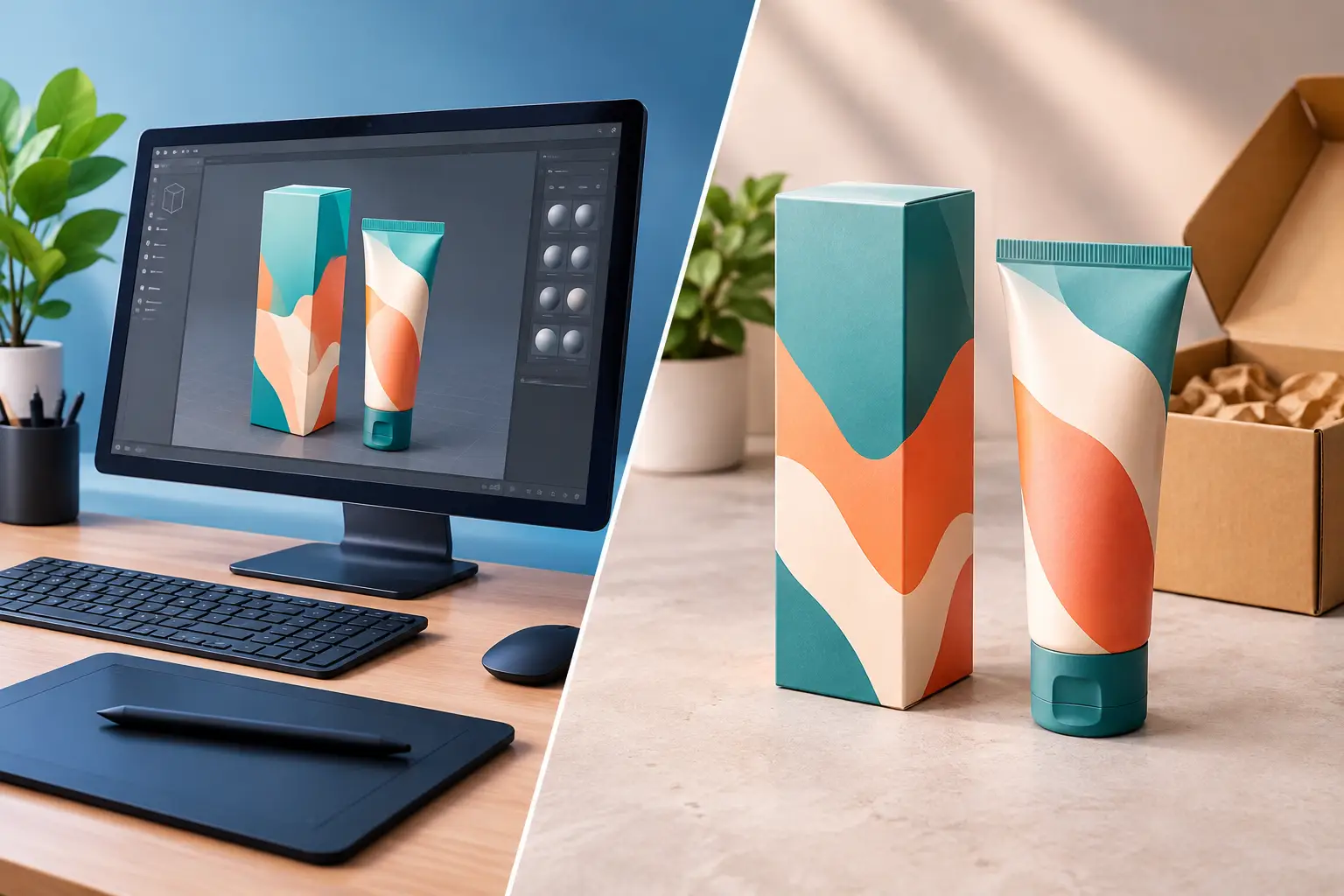
A packaging launch can be held up by one small but consequential detail: the final product simply is not ready to photograph. Artwork may still be changing, a bottle may be in tooling, or a full product range may not yet exist beyond a flat dieline. That is where CGI packaging versus physical mockups becomes a serious production decision, not a matter of visual preference.
For brand teams and agencies, the question is rarely whether CGI or physical craft can look convincing. At the highest level, both can. The more useful question is which method gives the campaign the required degree of control, speed and fidelity at the point it is needed. The answer depends on the product, the intended channels, the creative ambition and the decisions still in motion.
CGI packaging versus physical mockups: the real distinction
A physical mockup is a tangible prototype. It may be an early production sample, a hand-finished model, a printed label applied to an existing pack, or a fully engineered pre-production unit. It can be photographed, held, styled and assessed in real light. For certain projects, especially where tactile material behaviour is central, that physical presence remains valuable.
CGI packaging is a digitally built product asset, created with precise geometry, materials, print artwork, lighting and camera direction. It is not merely a product cut-out with a new label placed on top. A premium CGI asset recreates the structural and optical qualities that make packaging believable: glass thickness, foil reflections, embossing depth, varnish contrast, translucent liquids, condensation, folding boards and the subtle imperfections of a manufactured object.
The difference has major implications. A physical mockup captures a particular version of the pack in a particular set-up. CGI creates a controlled visual system around the pack, allowing the product, the environment and the point of view to be refined independently.
When physical mockups earn their place
Physical mockups are most persuasive when a team needs to inspect an object rather than simply communicate it visually. A premium carton with a complex opening mechanism, a fragrance bottle with unusual weight distribution, or a pack that must sit accurately within a retail display may require hands-on review. A mockup lets stakeholders evaluate scale, grip, assembly and finish without interpreting a screen image.
They can also be a strong option when a product is already available and the campaign brief is deliberately simple. If the objective is a natural editorial-style shoot with modest retouching, photographing real products may be commercially sensible. The creative team can respond to genuine texture and incidental detail in the moment, which can suit brands seeking an immediate, documentary quality.
However, physical does not automatically mean faster or more authentic on screen. Samples must be manufactured, shipped, protected and prepared. Labels can bubble, printed colours can shift, and a prototype may not match the final production specification. Retouching a physical shoot can resolve some limitations, but substantial changes to pack shape, artwork, finish or camera angle soon become costly.
Where CGI changes the production equation
CGI is particularly powerful when packaging is still evolving, when there are multiple variants, or when a campaign demands imagery that would be difficult to stage photographically. One accurately built master asset can support a whole product family across formats, flavours, markets and seasonal editions. A label update does not require another shoot. Neither does a new language version, a revised cap colour or an additional SKU.
That flexibility matters most when campaign development moves quickly. A hero visual may need to become a social crop, a retailer banner, a motion asset, a close-up film frame and a point-of-sale execution. With a CGI production, the product can be rendered from new angles and in new compositions while preserving exact brand consistency. The lighting can remain disciplined across every asset, even when the visual world changes.
CGI also offers an exceptional level of control over materials that are notoriously demanding in photography. Metallic inks, pearlescent coatings, clear plastics, glossy pouches and reflective aluminium cans can be art directed at a granular level. Rather than accepting an accidental highlight or a compromised reflection, the production team can shape how the surface behaves, where the logo remains legible and how the product earns attention in the frame.
For launch campaigns, this can allow visual production to begin before physical samples are approved. That is not an invitation to ignore packaging engineering. It is a way to separate visual development from the delays inherent in manufacturing, while keeping the digital asset aligned with the latest structural and artwork information.
Realism is not a software setting
The strongest objection to CGI packaging is usually realism. It is a reasonable concern, because mediocre CGI can look too perfect, too polished or physically implausible. The issue is not the medium. It is the quality of observation, art direction and execution behind it.
Believable packaging depends on the same principles as great product photography: an understanding of material, proportion, light and lens behaviour. A foil stamp should react differently from a satin laminate. A filled glass bottle should refract light differently from an empty one. A flexible pouch needs subtle tension and creasing, not a smooth, rigid silhouette. These details are where distinguished digital artists separate a convincing product image from a generic render.
The best work also knows when to preserve imperfection. Packaging that is clinically flawless can appear synthetic. A restrained scuff, a minute seam line, a slight variation in paper grain or a natural fall of condensation can make an asset feel observed rather than manufactured by software. The aim is not digital perfection. It is visual credibility on the brand’s terms.
Cost is about reuse, not only the first image
Comparing an individual CGI render with an individual studio photograph can produce a misleading budget discussion. A physical shoot may appear more economical when there is one product, one angle and no anticipated revision. Yet that calculation changes quickly if the client needs six variants, three markets, motion, seasonal overlays and alternate aspect ratios.
CGI has an upfront investment because the product must be modelled and surfaced with care. Once approved, though, that asset becomes a durable production resource. It can be adapted for future campaigns without rebuilding the product from scratch. This makes CGI especially compelling for global brands managing complex portfolios, frequent packaging updates or long campaign lifecycles.
Physical mockups have their own hidden costs: fabrication, couriering, studio time, specialist prop styling, reshoots and post-production. None of these make physical production the wrong choice. They simply mean the comparison should account for the entire asset programme, rather than the first deliverable alone.
A hybrid approach can be the strongest answer
Some of the most effective packaging campaigns combine both methods. A hero product can be created in CGI for maximum control, then composited into photographic environments or paired with live-action ingredients, hands and atmospheric details. Conversely, a photographed prototype can provide an invaluable physical reference for a CGI team producing the wider campaign system.
This approach is useful when the product must feel grounded in a recognisable world but the campaign requires scale beyond what a shoot can reasonably deliver. It also supports practical testing: teams can establish the physical truth of a material, then use CGI to art direct it across a broader visual universe.
The key is to decide early which elements need to be real, which need to be controllable and which need to be repeatable. Leaving that decision until after a shoot often creates avoidable compromises.
Choosing the right route for the brief
A physical mockup is usually the better route when tactile evaluation, real-world styling or a single uncomplicated execution is the priority. CGI is usually the stronger choice when product availability is uncertain, artwork remains live, visual ambition is high, or the campaign needs a scalable asset library.
The decision should also reflect the audience’s scrutiny. In luxury, beauty, food, pharmaceuticals and technology, packaging is often the product’s first proof of quality. Every reflection, material transition and typographic detail carries meaning. This is where a managed CGI production process, supported by specialist artists and transparent communication, can protect both creative standards and delivery confidence.
The most useful question for the next packaging brief is not whether CGI can replace a physical mockup. Ask whether the campaign needs an object for inspection, an image for persuasion, or a visual asset built to keep working long after launch day.