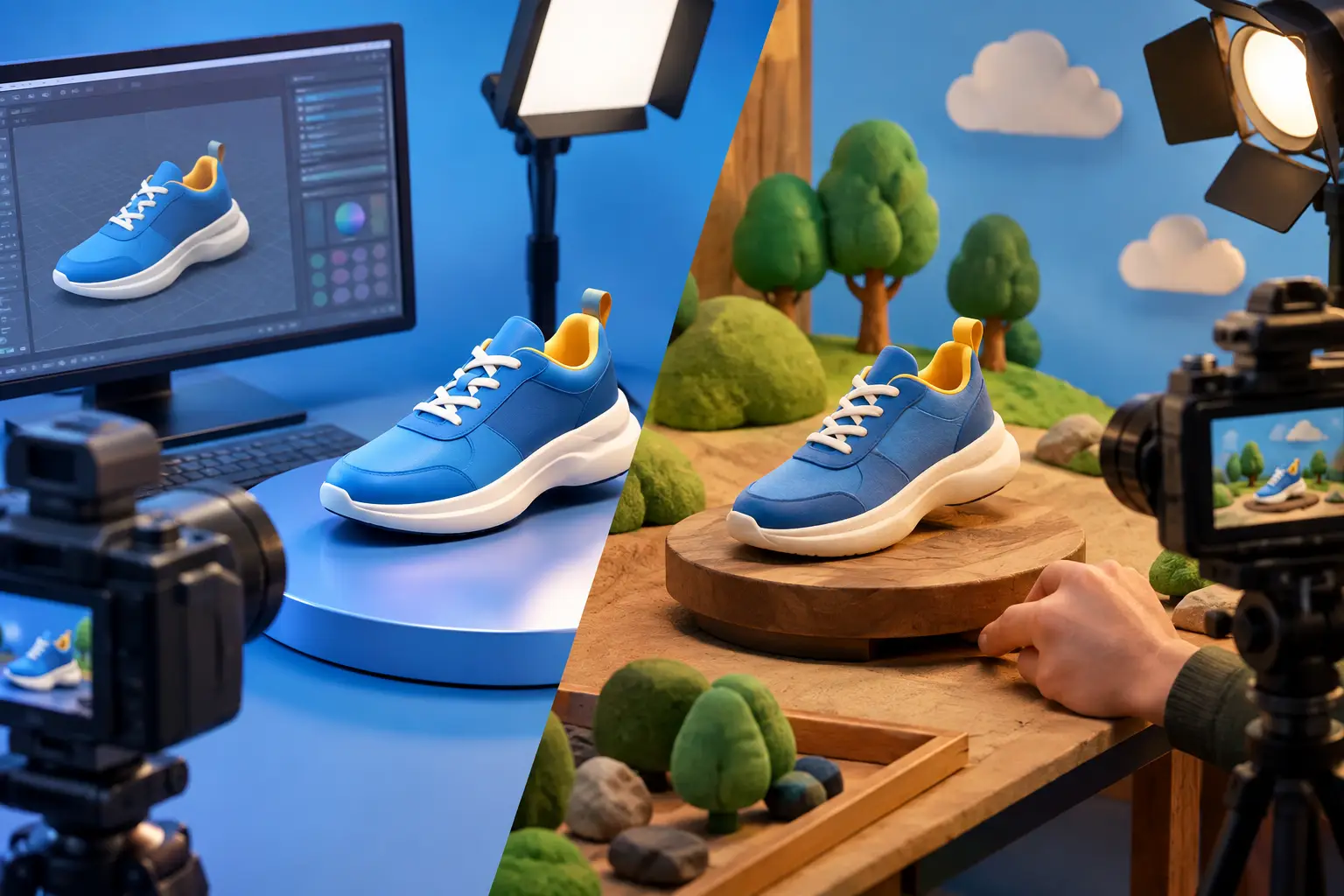
A product suspended in a perfect splash, a character with an unmistakably handmade gait, a package that catches light exactly as it will on shelf: each can command attention. Yet CGI versus stop motion is not simply a choice between digital polish and physical charm. For brand teams, it is a decision about control, production logic, asset longevity and the emotional register a campaign needs to own.
Both disciplines can produce exceptional work. Both demand serious craft. The stronger choice is the one that serves the idea, the product and the practical realities of the brief without compromising the standard of the final image.
CGI versus stop motion: the commercial difference
CGI creates imagery, objects and environments in three-dimensional digital space. Artists model forms, build materials, light scenes, animate movement and render final frames. Nothing needs to exist physically before production begins, although photography, physical samples and reference materials often inform the result.
Stop motion animates physical objects or puppets one frame at a time. A set is built, materials are selected, lights are positioned and the subject is adjusted in minute increments between exposures. Its appeal comes partly from evidence of the physical world: tactile surfaces, tiny imperfections, practical shadows and motion that has a distinct cadence.
For a commercial audience, the meaningful distinction is not whether one technique is more authentic. It is where each puts the creative risk. Stop motion commits earlier to a physical build and a finite shooting environment. CGI retains more variables within the digital production process, enabling a level of precision and revision that is especially valuable when product details, markets or deliverables are still evolving.
When stop motion earns its place
Stop motion can give a campaign a rare sense of presence. A clay character, hand-cut paper world or practical food transformation may feel deliberately crafted in a way that suits brands with a playful, artisanal or eccentric point of view. The technique asks viewers to notice the making, rather than conceal it.
That material honesty is particularly effective when texture is central to the story. Fabric fibres, rough paper edges, hand-painted surfaces and practical miniature sets can communicate warmth with very little explanation. The slight irregularity of frame-by-frame movement can become part of the brand expression, lending personality that would be difficult to replicate through conventional digital motion alone.
The constraints, however, are real. A change to packaging artwork, a new flavour variant or a revised product proportion after the shoot may require reshooting work that was already complete. Complex transformations can also demand extensive rigging, replacement elements and careful compositing. Stop motion is not a shortcut to character. It is a specialist production discipline whose charm depends on meticulous preparation.
Where CGI provides unmatched control
CGI excels when the campaign needs an image that could not be photographed, or could not be photographed with enough certainty. It can place a product inside an impossible environment, visualise invisible technology, control a liquid form at a frozen moment, or create a character whose performance must work across film, social, retail and out-of-home formats.
For product-led brands, the advantage often begins with accuracy. A distinguished CGI artist can study a physical sample, CAD data or technical specifications and recreate the product with exacting attention to geometry, finish, translucency and light response. The result can be art-directed before a shoot date would even have been possible.
This matters in categories where the product is still in development, too delicate to shoot repeatedly, unavailable in all markets or required in numerous versions. A single approved digital asset can support new camera angles, colourways, pack configurations, localisation and seasonal campaign adaptations. That does not remove the need for judgement. It creates a production environment in which judgement can be applied with far greater control.
CGI also offers a broad stylistic range. It can be photoreal, graphic, surreal, intentionally tactile or highly stylised. The question is not whether it can imitate the physical world. The question is what visual language will make the brand feel most distinctive and most credible to its audience.
The question of realism is usually the wrong one
Clients sometimes frame the choice as real versus artificial. This can obscure the actual creative objective. Stop motion is constructed. CGI is constructed. Each can look naturalistic or overtly designed, depending on the direction, materials, lighting, animation and finishing.
A realistic result is not automatically a persuasive one. A pharmaceutical visual may need clinical clarity rather than literal realism. A sport campaign may require exaggerated movement and impossible camera work to express performance. Food imagery may benefit from controlled surfaces and stylised ingredient motion, provided the product remains appetising and truthful to the brand.
The more useful question is: what should the audience feel in the first second? If the answer is intimacy, craft and playful materiality, stop motion may offer the right visual cue. If it is aspiration, technical mastery, scale or immaculate product desirability, CGI is often the stronger route.
Motion reveals the choice
Movement is where the distinction becomes most apparent. Stop motion has a frame-by-frame rhythm that can feel energetic, charming or deliberately strange. It is well suited to ideas that celebrate the object as an object.
CGI can create movement with extraordinary fluidity, weight and camera freedom. It allows a lens to travel through a product, follow a microscopic process, orbit a trainer at speed or choreograph hundreds of elements with repeatable precision. For campaigns requiring multiple edits and aspect ratios, that flexibility has substantial value.
Time, change and campaign scale
Neither technique should be judged by a simplistic claim that one is faster. The schedule depends on the complexity of the idea, the number of assets, approval stages and the quality threshold. A modest stop-motion film can move efficiently with a decisive brief. A sophisticated CGI sequence requires time for look development, modelling, surfacing, animation, lighting and rendering.
The difference emerges when change enters the process. CGI is generally better positioned for revisions after principal creative decisions have been made. A revised camera angle, new composition, additional product variant or alternate end frame can often be managed from an existing scene. The work may still be significant, but the production is not tied to rebuilding a set and returning to a shoot.
This makes CGI particularly effective for integrated campaigns. The same core asset can be developed into hero film, stills, social cut-downs, retailer content, digital display, packaging visualisation and regional adaptations. It is a considered investment in a visual system rather than a single moment of production.
At Best of Breed, this is where an agency-led approach matters. The right specialist is selected not only for their aesthetic signature, but for their ability to deliver the technical demands, asset requirements and approval process behind the campaign.
Cost is about certainty, not just the initial estimate
Stop motion budgets include physical fabrication, studio time, crew, equipment, materials, animation and post-production. CGI budgets reflect the complexity of asset creation, artistic development, simulation, animation, rendering and compositing. Both can sit at a premium level when the work demands exceptional execution.
The better financial question is what must be protected. If the campaign needs a singular handmade film with limited future adaptations, stop motion can be a purposeful investment. If a product must appear in many markets, formats and versions, CGI may offer stronger long-term efficiency because the approved digital build continues to create value.
Cheap CGI is rarely economical if it fails at the most visible details: product proportions, material behaviour, lighting, typography integration or motion. Equally, an under-resourced stop-motion production can lose the very tactility and precision that made the technique attractive. Premium visual work benefits from clear scope, early alignment and enough time to do the craft properly.
A hybrid route can be the most distinctive answer
The choice is not always binary. Some of the most compelling commercial work combines practical and digital techniques. A physical set can provide genuine texture and unpredictable light, while CGI extends the environment, removes rigs, adds impossible movement or introduces product elements that require absolute control.
Hybrid production is particularly valuable when a campaign needs tactile credibility without accepting every practical limitation. The method must be designed from the outset, however. Decisions about camera, lighting, scale, tracking and asset handover cannot be left until post-production. A convincing hybrid film is the result of one visual idea, not two techniques placed beside each other.
Choosing the right production approach
Before selecting a method, define the decision around the campaign rather than personal preference. Four questions usually clarify the route:
- Does the product need exact representation across multiple variants, markets or future assets?
- Is tactile imperfection part of the creative idea, or would it distract from the product?
- Does the concept require impossible camera work, transformations or environments?
- How likely is the brief to change after the initial shoot or animation stage?
If the answer centres on scalable precision, evolving products and controlled spectacle, CGI is likely to provide the stronger foundation. If the campaign depends on visible material craft and the idea is designed for a contained physical production, stop motion may be the more memorable choice.
The most useful next step is to bring the creative ambition, the asset plan and the approval realities into the same conversation early. When the production method is chosen with that level of clarity, it stops being a technical preference and becomes part of the campaign’s point of view.