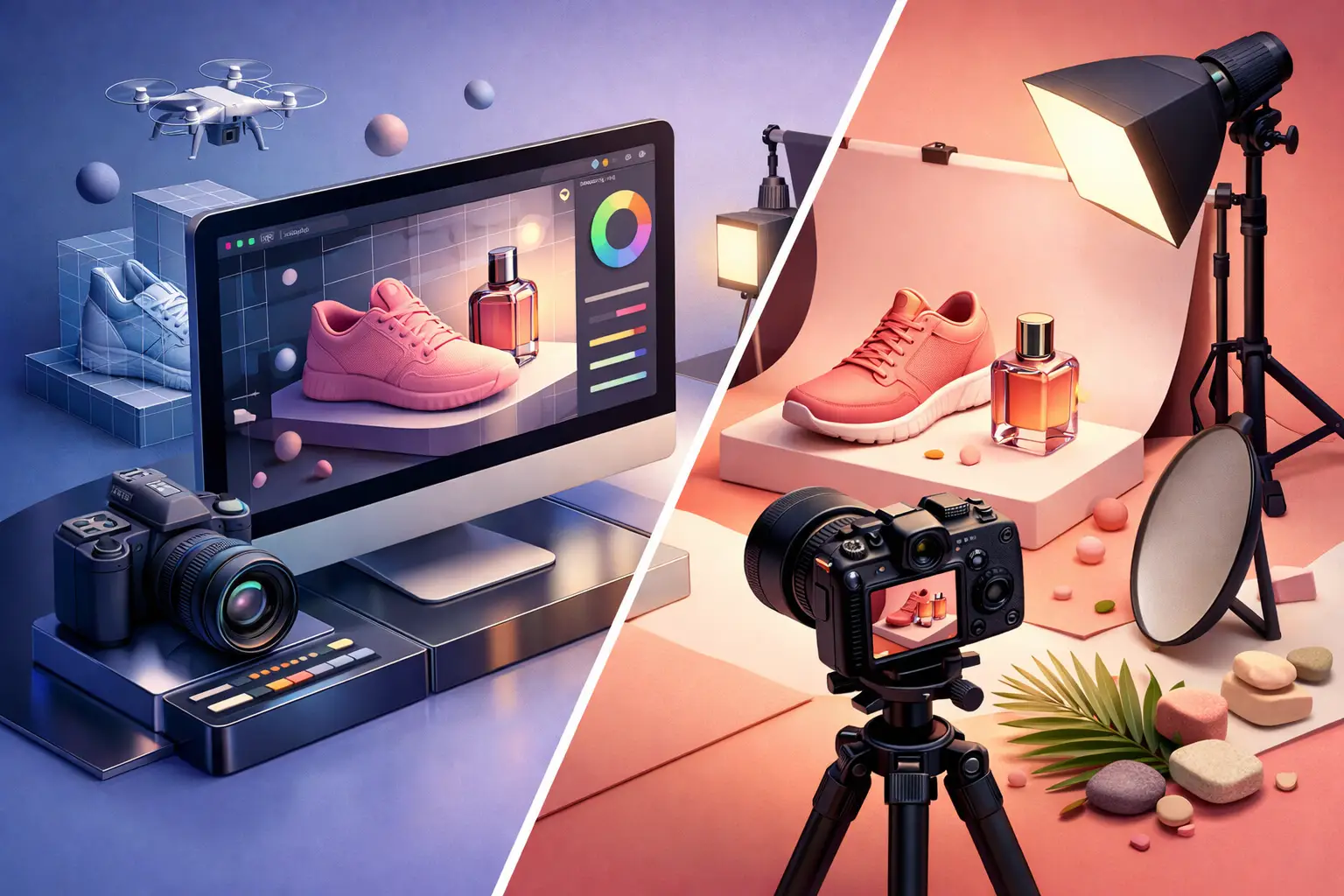
A single campaign image can carry an impossible brief: show a product at its most desirable, preserve absolute brand accuracy, work across every market, and still feel immediate enough to stop a scroll. That is where the decision between CGI vs photography advertising becomes strategic rather than stylistic. Both disciplines can produce exceptional work. The stronger choice is the one that gives the creative idea the right conditions to succeed.
Photography remains unmatched when a campaign needs the irreducible texture of real life: genuine human expression, spontaneous movement, atmospheric weather or the tactile imperfections that make an image feel observed rather than constructed. CGI, meanwhile, gives brands command over every element in the frame, from the curve of a pack to the physics of a liquid pour.
The question is not whether CGI can replace photography. It is whether photography is the most effective production method for the image your campaign requires.
CGI vs photography advertising: the real distinction
The conventional comparison often begins with realism. This is too narrow. At the highest level, both CGI and photography can appear entirely credible. The meaningful distinction is control.
A photograph records a moment assembled in the physical world. It depends on a location, product samples, cast, styling, lighting, equipment and a tightly coordinated shoot day. That constraint can be creatively valuable. It introduces chance, material truth and a sense of human presence that cannot always be art-directed into existence.
CGI constructs the moment from the ground up. A product can be rendered before final manufacture, held in a position that would be physically impossible, or placed in an environment that would be prohibitively expensive or unsafe to build. The colour of a surface, the density of a cloud, the amount of condensation on a bottle and the behaviour of every reflection can be refined with precision.
For advertising, this makes CGI particularly powerful when a campaign has no room for visual compromise. It allows the art direction to lead, rather than asking the idea to accommodate the limits of a shoot.
Where photography remains the right choice
Photography has a particular authority when the subject is lived experience. A portrait-led fashion campaign, an editorial sports image or a documentary-style food story may benefit from the energy of a real set. The interaction between people, clothing, light and movement is difficult to simulate convincingly when the desired result is intentionally unpolished or emotionally immediate.
It can also be the more efficient option for a straightforward brief. If a finished product, accessible location and simple shot list are in place, a well-planned shoot may deliver the required asset quickly. There is little value in building a complex digital scene merely because CGI is available.
However, a photograph is not automatically simpler. It can require substantial retouching, prop sourcing, travel, contingency planning and reshoots. Small changes after the shoot, such as a revised packaging label or a different product finish, may require costly post-production or another day of production altogether. Photography performs best when the brief is stable and the physical world can deliver the intended visual without extensive intervention.
Where CGI creates a commercial advantage
CGI comes into its own when the campaign needs precision, flexibility or scale. For product launches, it can create hero imagery before physical samples are complete. That removes a common bottleneck between product development and marketing, allowing brand teams to prepare campaign assets, retailer content and launch films in parallel.
The same product model can also become a long-term production asset. Once built to an appropriate standard, it can be rendered from new viewpoints, in new colourways, formats and environments without recreating the product from scratch. A premium cosmetic jar might appear in a still-life campaign, a social animation, a retail visual and a regional adaptation, all while retaining exact material and brand details.
This is not a shortcut to lower-quality work. High-end CGI demands specialist craftsmanship in modelling, lighting, surfacing, compositing and art direction. The value lies in the ability to refine every decision until the image meets the brief, then extend that investment across a wider campaign system.
Products that benefit from digital precision
Certain categories make the case especially clearly. Food and beverage imagery often requires ingredients to look immaculate under conditions that are difficult to sustain on set. CGI can preserve the crispness of a garnish, the sheen of a sauce or the ideal form of a splash, without the practical limits of time and gravity.
For technology, CGI can reveal internal engineering, demonstrate features through cutaways and place devices in highly controlled future-facing environments. In pharmaceutical communications, it supports accurate visualisations of mechanisms, molecules and medical benefits where photography alone cannot explain the story. Packaging and premium consumer goods benefit from flawless geometry, exact colour management and carefully choreographed reflections.
In each case, CGI is not simply making an image. It is making the product legible, desirable and consistent across every touchpoint.
Cost is about scope, not just a line item
A direct cost comparison can be misleading. Photography may appear less expensive at the outset, while CGI may involve a greater initial investment in creating the digital asset. Yet the calculation changes when a brand requires multiple markets, product variants, aspect ratios and ongoing adaptations.
A physical shoot accumulates costs through studio hire, crew, talent, equipment, props, sample logistics, travel and retouching. It may be the right investment for a single defining image. But each material campaign change can reopen part of that process.
CGI concentrates more of the investment into planning and asset creation. Once the product model, visual language and scene are established, variant production can be more efficient and predictable. This is particularly valuable for global brands managing frequent updates or extensive product ranges.
The decision should therefore account for the full asset lifecycle. Ask whether the image is a one-off execution, or the foundation of a campaign that will need to evolve for months. The latter often justifies a CGI-led approach.
Realism depends on artistic judgement
The phrase “photoreal CGI” can suggest that technical detail alone produces belief. It does not. Realism is an artistic discipline. It comes from understanding how light behaves on materials, where reflections should fall, how imperfections add credibility and which details the eye notices first.
The danger is not that CGI looks digital. The danger is that it looks generic: a perfect but unconsidered image with no visual point of view. Distinguished artists avoid this by treating the render as a crafted photograph, with deliberate composition, lighting and surface character.
Equally, photography is rarely untouched reality in commercial work. It is carefully styled, lit, graded and retouched. The audience is responding to the final image, not the production method behind it. What matters is whether the visual feels truthful to the brand and compelling to the person seeing it.
The strongest work is often hybrid
The most effective answer is sometimes neither CGI nor photography in isolation. Hybrid production combines the strongest qualities of each. A campaign might photograph a real model and wardrobe, then use CGI for product visualisation, impossible set extensions or controlled environmental effects. Alternatively, a CGI product may be composited into photographed landscapes to retain the unpredictability of natural light.
This approach is especially useful where human authenticity is essential but the product must remain immaculate, adaptable or unavailable at the time of the shoot. It does require rigorous pre-production. Perspective, lighting references, camera data and compositing intent need to be agreed before assets are created. Without that discipline, the join between real and digital elements becomes visible.
A managed CGI production partner can bring the appropriate specialists together early, ensuring that creative ambition, technical execution and delivery requirements remain aligned from brief to final asset.
Choose the method that protects the idea
Begin with the creative question, not the production preference. Does the campaign need a real human moment, or an image the physical world cannot reliably deliver? Is the product finished and available? Will the assets need regional versions, new formats or revised packaging? Does the visual rely on the accidental beauty of a location, or on absolute command of every highlight and contour?
Photography can give a brand immediacy and emotional texture. CGI can give it precision, range and a level of visual possibility that a shoot cannot always reach. The best decision respects both disciplines while refusing to let production habit dictate the work.
When the image has to become the defining expression of a product, choose the process that lets the idea remain uncompromised.