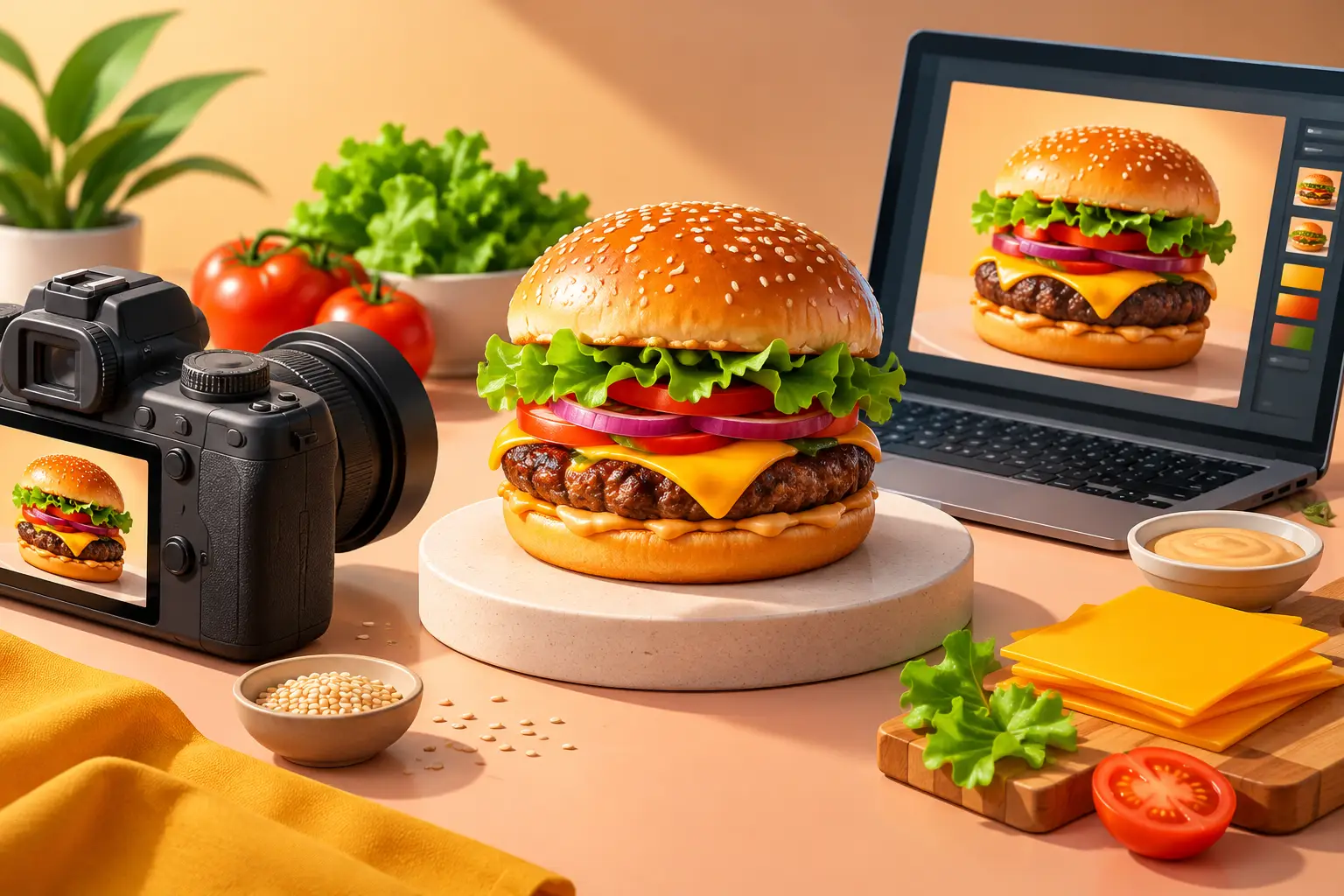
A crisp splash of milk, a perfectly fractured chocolate shell, steam lifting from a bowl at precisely the right moment: these are not incidental details. When brands create food renders for advertising, every surface, shadow and imperfection has a commercial purpose. The image must make a viewer feel something immediate, while meeting the exact demands of a campaign, pack design or film sequence.
That is why premium food CGI is not simply a substitute for a photoshoot. It is a controlled creative medium, capable of producing food at its most desirable and making that visual world repeatable across every market, format and channel.
Why food rendering is a specialist discipline
Food is among the most recognisable subjects in commercial imagery. People know instinctively when melted cheese is too glossy, when a strawberry lacks the fine irregularity of real seeds, or when condensation looks placed rather than formed. A render can be technically immaculate and still fail if it does not communicate freshness, temperature, weight and texture.
The standard is especially high because food advertising works at close range. Packaging, social assets, out-of-home placements and film all invite scrutiny. A hero ingredient needs to survive a billboard crop, a mobile screen and a high-resolution print execution without losing its appetising quality.
Distinguished CGI artists approach this as a study in material behaviour. They observe how light travels through a translucent drink, how oil catches a highlight on roasted vegetables, and how a baked crust breaks unevenly. The strongest work uses those observations to build an image that feels convincing without becoming literal or clinical.
The brief defines the appetite appeal
Before a 3D asset is built, the production team needs to understand what the image is designed to achieve. A premium chocolate campaign may call for rich contrast, sculptural shadows and a restrained palette. A family-ready frozen-food pack may need generous portions, clear ingredient recognition and warmth that reads instantly at shelf distance. Neither approach is more correct. Each serves a different brand proposition.
A useful food CGI brief establishes the product truth, the desired emotional response and the practical delivery requirements. It should clarify the product or recipe, ingredient hierarchy, serving context, reference photography, pack architecture, crop options and markets. If the product is still being developed, a CGI route can also accommodate evolving recipes or packaging without requiring repeated shoots.
This planning stage is where managed production earns its value. A beautiful key visual is only part of the assignment. Brand teams frequently need an asset system: alternative layouts, cut-downs, animation frames, retailer-ready crops and files designed to integrate with typography or pack artwork. Defining this early protects both the creative idea and the production schedule.
How to create food renders with believable materials
Believability begins with the food itself. Artists model the primary forms, then introduce the details that prevent digital perfection from becoming sterile. A bun has slight asymmetry. A handful of crisps varies in curvature and seasoning. A sauce gathers in thicker areas rather than coating every surface evenly.
Texture must carry the story
The material qualities of food are rarely uniform. A single avocado can contain matte skin, moist flesh, fibrous edges and a reflective cut surface. A successful render separates these behaviours through detailed texture work, displacement, translucency and carefully controlled roughness. The objective is not maximum detail in every centimetre. It is the right detail where the eye expects it.
Scale is equally decisive. Fine salt, crumbs, air bubbles and grill marks all act as visual cues. If they are oversized or too evenly distributed, the viewer may not be able to explain what is wrong, but the image will lose credibility. This is where artists with dedicated food experience bring a material advantage: they know which irregularities read as delicious and which look accidental.
Light creates temperature and tactility
Lighting determines whether a drink feels ice-cold, whether a dish appears freshly cooked, and whether a biscuit looks crisp rather than dry. It also establishes the campaign’s visual language. A hard, directional light can lend a premium editorial quality; softer lighting can make a meal feel generous, familiar and approachable.
The most effective lighting is designed around the product’s key appetising signals. Highlights might define a glaze, reveal the fizz in a beverage or give a fresh berry its natural bloom. Shadow is not simply added for drama. It gives food volume, anchors objects in the composition and helps the viewer understand scale.
Controlled imperfection prevents the CGI look
Food in advertising is aspirational, but it should not be geometrically flawless. The challenge is to introduce variation with judgement. Too much disorder can make a product feel careless. Too little creates a synthetic result.
This balance is often established through art direction rather than software alone. A creative director may ask for one broken edge in a cookie, a slightly off-centre garnish or a restrained scatter of crumbs that leads the eye towards the pack. These gestures give the image life while keeping it composed enough for commercial use.
CGI gives campaigns more than a single hero image
Traditional food photography remains the right choice for many assignments, particularly when a live chef performance, a specific location or a documentary sensibility is central to the idea. CGI becomes particularly compelling when physical constraints limit the work or when the campaign demands extensive variation.
A digital food asset can be refined long after the initial creative development. The camera can move, a glass can be reframed, a background can shift from a studio setting to a stylised world, and ingredients can be rearranged for local pack variants. Animation can extend the same visual language into a slow pour, an ingredient transformation or a precise product reveal.
This flexibility has a financial dimension, but it should not be treated as a shortcut. High-end CGI requires time, specialist judgement and rigorous review. Its value lies in reducing compromises that might otherwise be imposed by melting products, short shooting windows, unavailable ingredients or the need to produce multiple versions at speed. Where a campaign needs consistency over months or across territories, a well-built digital asset can become a durable production foundation.
Build the production around approvals, not assumptions
The approval process is often where food imagery succeeds or stalls. Stakeholders may have different priorities: brand teams protect recognisability, packaging teams need clarity at small sizes, legal teams require accurate claims, and creative partners focus on distinctiveness. Waiting until final rendering to resolve these perspectives risks expensive rework.
A disciplined workflow brings key decisions forward. Early composition studies establish the visual hierarchy. Greybox or clay previews confirm proportion and camera angle. Material and lighting tests allow teams to assess appetite appeal before every detail is complete. Final-stage reviews then focus on polish, colour management and delivery quality rather than fundamental creative questions.
Transparent communication is particularly valuable when a campaign involves multiple agencies, markets or production partners. Clear feedback rounds, consolidated notes and agreed reference points keep artistic decisions intentional. They also give specialist artists the space to improve the work, rather than spending late-stage time interpreting conflicting comments.
The standard to hold every render against
A food render should not merely look real. It should make the product feel worth choosing. That requires technical mastery, but it also requires an understanding of composition, brand desire and the context in which the image will appear.
For brands commissioning high-impact food CGI, the right question is not whether an image can be made in 3D. It is whether the production team can translate a product’s most compelling qualities into a visual asset with lasting campaign value. When artistry, planning and material realism meet, the result is not just food on screen. It is a reason to look twice.