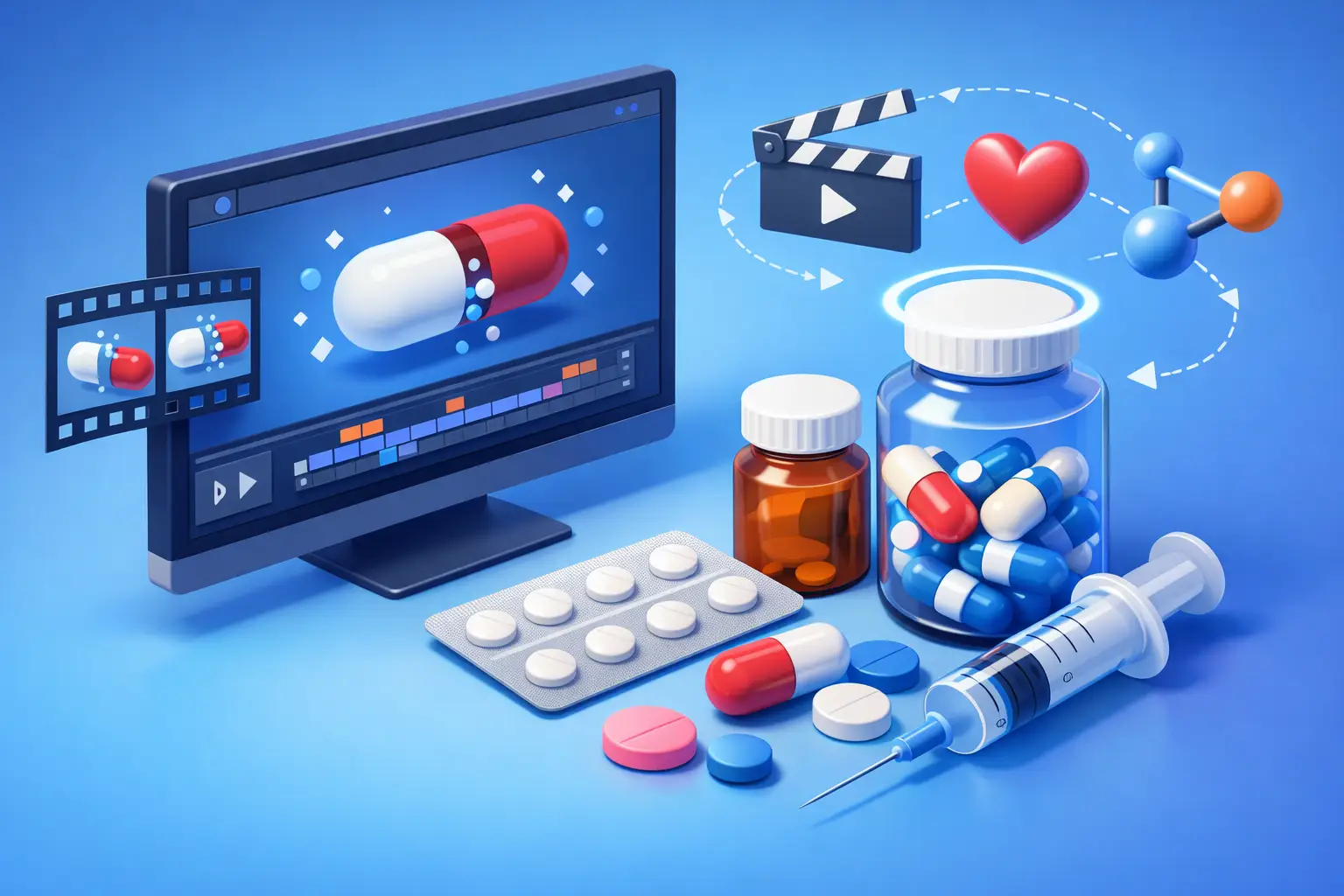
A medicine animation may last only 15 seconds, yet it can carry the weight of years of research, a tightly controlled claims framework and a patient’s understanding of their treatment. Knowing how to animate medicine is therefore not simply a question of rendering a tablet beautifully or making a molecule move. It is the discipline of translating complex science into an image that is immediate, accurate and worthy of trust.
For pharmaceutical brands, the strongest CGI work does not make science look simpler by stripping out its meaning. It gives the science a clear visual hierarchy, so the right audience can understand the right idea at the right moment.
How to animate medicine without losing trust
The first decision is not stylistic. It is strategic: what must the viewer understand after the animation ends? A brand team may need to explain a mechanism of action, distinguish a delivery format, visualise a therapeutic target or give a product launch a more memorable visual language. Those are very different briefs, even when the subject is the same medicine.
A mechanism-of-action film, for example, needs scientific logic. The viewer should be able to follow the relationship between the active ingredient, its target and the intended biological effect. A campaign film for a consumer healthcare product may instead focus on sensation, speed of use or an elegant product reveal. Both can be visually exceptional, but they require different levels of abstraction, pacing and review.
The trade-off is always clarity versus completeness. Attempting to include every pathway, receptor and clinical qualification can produce a technically correct animation that nobody retains. Reducing the story too far can make it feel generic, or worse, imply more than the approved evidence supports. The answer is a carefully chosen visual argument, built around one central idea.
Begin with evidence, not imagery
The most polished animation cannot compensate for an imprecise scientific foundation. Before treatments, tissues or particles are designed, the production team needs a reliable source pack. This usually includes approved claims, study data where relevant, medical reference materials, product specifications, brand guidelines and a clear list of required safety information.
This stage benefits from direct access to medical, legal and regulatory stakeholders. Their involvement is not a late-stage obstacle to creativity. It establishes the boundaries inside which creativity can work with confidence. If a molecule is shown binding to a target, for instance, the visual must not accidentally suggest an unapproved indication, an absolute outcome or a clinical effect that the evidence does not substantiate.
A useful brief separates three layers of information. First, identify the scientific facts that must remain exact. Secondly, define the communication message the audience needs to take away. Finally, establish where visual interpretation is permitted. An atomically accurate molecular structure may be essential in one piece of scientific communication and unnecessary in another, where a refined, branded particle system communicates the idea more effectively.
Set the audience and environment early
A congress audience can absorb more detail than a general consumer audience. Healthcare professionals may expect anatomical specificity, labelled pathways and a more measured pace. A public-facing campaign may need a single intuitive metaphor, carefully managed language and a warmer emotional register.
Context also shapes the animation. A film shown on a large exhibition screen can reward atmospheric scale and patient observation. A short social asset needs to establish the product or mechanism within the first seconds, often without sound. A modular campaign requires compositions that crop successfully across widescreen, vertical and square formats. These choices are most economical when resolved before production begins.
Choose a visual language that serves the science
CGI gives pharmaceutical communications unusual flexibility. It can move from a macro product shot to an interior biological environment without a visible break. It can show invisible processes with controlled lighting, measured motion and a degree of precision that live action cannot easily deliver. But visual power should never become visual noise.
For molecular or cellular storytelling, the art direction should establish what is literal and what is interpretative. Cell membranes, proteins and receptors often need a degree of simplification so that the intended interaction can be seen. The audience does not need a crowded simulation of every biological process occurring simultaneously. It needs a credible environment that directs attention towards the relevant action.
Colour is particularly consequential. A palette may differentiate active and inactive elements, signal a change in state or connect the science to the wider brand world. It should not imply danger, inflammation, relief or efficacy without careful consideration. High-contrast visual effects can be compelling, but when they carry meaning, that meaning must align with the approved narrative.
Product animation demands the same restraint. The texture of a capsule shell, the reflectivity of a blister pack, the liquid behaviour of a formulation and the legibility of a device mechanism all influence perceived quality. Premium CGI can present these details with exceptional control, while still retaining the practical truth of the product.
Build the story in boards before building it in 3D
A storyboard is where scientific accuracy, campaign intent and cinematic craft meet. It is far more than a sequence of attractive frames. Each shot should have a job: orient the viewer, introduce the challenge, demonstrate the interaction, reveal the product or land the message.
At this point, timing matters as much as composition. Molecular interaction needs enough screen time to be understood, but not so much that it becomes static. Product reveals need visual anticipation, yet must not delay essential information. A considered animatic – a timed sequence using draft imagery, sound and text – exposes these issues before costly 3D work begins.
When planning a film, allow room for labels, mandatory copy and end frames from the outset. Trying to add them after the visual composition is complete usually creates cramped, compromised assets. For international work, plan for varying copy lengths and local review requirements as well. A beautifully balanced English-language frame may not accommodate another market without adaptation.
Make movement explain, not decorate
The most persuasive medical animation uses motion as a teaching tool. Movement can establish cause and effect, show directionality, isolate a target or demonstrate how a delivery device operates. Every camera move and particle trail should improve comprehension.
A camera travelling through tissue can establish scale and place the viewer inside a biological system. A controlled pause before a binding event can make the central mechanism legible. A shift in depth of field can separate the therapeutic action from surrounding biological activity. These are cinematic decisions, but they are also communication decisions.
Avoid default visual shortcuts. Swirling particles, excessive lens effects and explosive transformations may make a sequence feel dramatic, but they can reduce confidence if they obscure what is actually happening. In pharmaceutical CGI, sophistication often appears as control: purposeful movement, precise material work and enough visual breathing room for the message to register.
Treat review as part of the production design
Pharmaceutical review cycles are unavoidable, but they need not be chaotic. The strongest process builds clear approval points around the brief, script, storyboard, animatic, key visual frames and final animation. At each stage, reviewers should know exactly what they are approving.
A single, consolidated feedback route is invaluable. It protects both quality and schedule by preventing contradictory notes from multiple stakeholders. Comments should distinguish between factual corrections, legal or regulatory requirements, brand preferences and subjective creative responses. These categories do not carry the same urgency, and treating them as though they do creates unnecessary friction.
For technically dense work, it can be useful to approve a small number of fully developed key frames before animating the entire film. This confirms the anatomy, molecular interpretation, lighting, materials and visual tone. It also gives the client a dependable view of final quality before the production moves into its most intensive phase.
Plan for a system of assets, not one film
A high-value medicine animation rarely exists in isolation. The same visual world may need to support a launch film, product pages, congress screens, sales presentations, paid social, still imagery and cut-down edits. Designing for this ecosystem from the first treatment protects consistency and makes the original investment work harder.
This does not mean every asset should be a shortened version of the hero film. Different placements demand different stories. A six-second asset may focus on one clear interaction. A still can isolate the product against a distinctive biological backdrop. A longer presentation sequence can give the mechanism the detail it requires. The central visual language remains consistent, while the communication adapts to its setting.
For brands commissioning complex CGI, this is where experienced production management becomes as valuable as artistic mastery. A curated team of distinguished artists can bring specialist molecular, product, character or motion expertise to the brief, while a single production partner maintains continuity across every deliverable.
Give science the visual standard it deserves
Medicine animation succeeds when the viewer feels guided rather than impressed at. The work should make difficult information easier to see, while respecting the evidence, the audience and the brand behind it. That standard calls for exceptional craft, transparent collaboration and the confidence to let one well-made idea carry the film.
When the science is treated with precision and the imagery with imagination, CGI can give a medicine more than movement. It can give its story a form people understand, remember and trust.