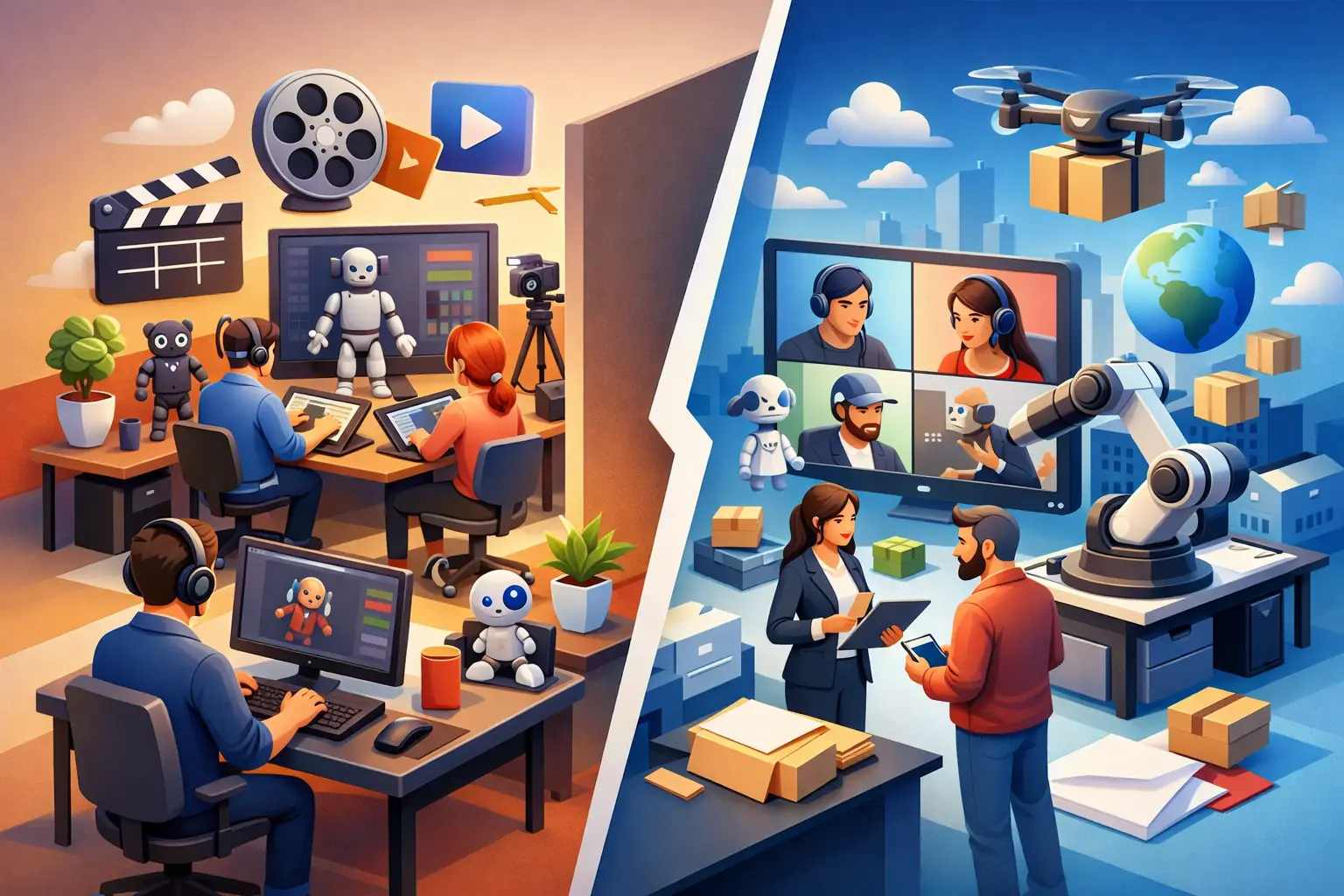
In-House vs Outsourced Animation: Choosing the Right Production Model
A campaign can be strategically sound, beautifully art-directed and perfectly timed, then lose its impact in the final seconds because the animation feels generic. For brand teams under pressure to produce distinctive visual work at pace, the question of in-house vs outsourced animation is not simply a resourcing decision. It determines the level of craft, creative range and production assurance behind the finished asset.
The right answer depends on what the work must achieve. A social adaptation with established brand templates calls for a different model than a hero film introducing a new product, a photorealistic food sequence or a technical pharmaceutical visualisation. The strongest production choice begins with an honest assessment of the brief, not a default preference for keeping work close or sending it elsewhere.
In-House vs Outsourced Animation: The Real Distinction
An in-house animation team offers proximity. The people creating the work understand the brand system, internal approval routes and day-to-day priorities. For recurring content, this familiarity can reduce briefing time and keep visual communication consistent across a busy calendar.
Outsourced animation offers depth of specialism. Rather than relying on the capabilities available within one permanent team, brands can appoint artists and studios whose skills are precisely suited to the assignment. That might mean a character specialist for a launch film, a CGI food artist for an appetising packshot sequence or a technical animation team capable of making a complex product mechanism clear and compelling.
Neither route is inherently superior. The mistake is treating animation as a uniform commodity. Motion design, 3D product CGI, VFX-led storytelling, stylised character work and scientific visualisation each demand different artistic and technical disciplines. A model that works efficiently for one can compromise another.
When an In-House Team Is the Right Choice
In-house production is most compelling when volume, continuity and speed are the priority. A brand producing frequent paid social assets, retail screen loops, editorial motion or regional format adaptations benefits from a team that can respond without the repeated ramp-up of an external engagement.
It also gives creative leadership direct visibility over work in progress. Informal conversations can resolve minor questions quickly, while brand guardianship remains close to the work. For organisations with a mature visual identity and clearly documented motion principles, this can be highly effective.
However, proximity should not be confused with unlimited capacity or capability. Internal teams must often manage competing priorities, compressed timelines and a broad remit. The same animator may be expected to handle presentation assets, always-on content and a flagship campaign film. That arrangement can be sensible, but it may not leave the space for the concentrated experimentation, simulation, lighting or compositing required by a high-end CGI production.
There is also a cost consideration that is frequently oversimplified. Salaries are only part of the investment. Premium animation may require specialist software, render infrastructure, asset libraries, motion capture, technical direction and senior creative oversight. Maintaining all of this internally makes the most sense when demand is both substantial and predictable.
Where Outsourced Animation Earns Its Value
Outsourcing is not merely a way to add hands during a busy period. At its best, it is a way to bring the exact creative authority a brief deserves. An experienced external production partner can assemble a tailored team around the visual challenge rather than force the challenge through a fixed internal capability.
For campaigns where the work must create a new visual language, this distinction matters. A distinguished CGI artist may bring an established mastery of materials, anatomy, product lighting or cinematic composition that would take years to cultivate in-house. That expertise is visible on screen. It affects the weight of a fabric, the believability of a liquid, the tactility of packaging and the emotional rhythm of a character performance.
External partners also offer useful perspective. They can challenge assumptions that have become familiar within a brand while still respecting the strategy and identity behind the brief. This is particularly valuable when a campaign needs to feel unmistakably on-brand without repeating what the audience has already seen.
The trade-off is that outsourcing requires a disciplined production process. A vague brief, fragmented feedback or late-stage changes will create friction, regardless of how talented the artists are. The strongest partners reduce that risk through clear scoping, defined creative milestones, transparent communication and senior production management from initial treatment to final delivery.
Quality Is a Production System, Not a Final Polish
Animation quality is often discussed as if it can be added at the end: refine the render, improve the grade or make the movement more premium. In reality, quality is established much earlier. It starts with the calibre of the concept, the rigour of pre-production and the decisions made before a single frame is rendered.
This is where external specialists can have an advantage on ambitious assignments. They are accustomed to building the right pipeline for the work, whether that involves bespoke modelling, look development, simulation tests, storyboards, animatics or detailed lighting studies. Each stage protects the final image from expensive surprises.
An internal team can achieve the same discipline where it has the seniority, time and technical support. However, if the brief requires unfamiliar techniques, the apparent saving of keeping production in-house can disappear through trial and error. A campaign deadline is a poor environment for learning a new visual discipline at scale.
For decision-makers, the practical question is not, “Can our team make this?” It is, “Can our team make this at the standard the campaign requires, within the available time, while protecting other priorities?” Those are very different questions.
Cost Should Be Measured Against Risk and Reuse
External production fees can appear higher because they make the full cost of specialist craft visible. Internal costs are often distributed across salaries, equipment and wider operating budgets, which can make them feel less immediate. A fair comparison considers the complete picture: production time, senior oversight, revision risk, opportunity cost and the lifespan of the final assets.
A hero animation that establishes a product’s visual identity may be repurposed across launch films, ecommerce, out-of-home, retail screens, social cut-downs and future campaign activity. In that context, investing in a bespoke master asset can be commercially sound. The production must be planned for reuse from the start, with deliverables, crops, formats and modular elements considered during pre-production.
Conversely, paying premium external rates for routine adaptations can be inefficient. These are often ideal assignments for an internal team that knows the templates and can move quickly. The best model is frequently hybrid: keep high-volume, brand-system work close to the business, then commission specialist partners when the creative or technical threshold rises.
A Practical Way to Make the Decision
Before appointing a team, assess the brief against four areas: creative ambition, specialist complexity, production volume and commercial importance. A short-form asset can still demand exceptional craft if it is the centrepiece of a major launch. Equally, a longer film may be straightforward if it follows an established toolkit.
Creative ambition asks whether the work needs to establish a new aesthetic, create memorable brand equity or compete in a high-attention media environment. Specialist complexity considers what is actually being animated: realistic materials, organic movement, technical processes, characters or intricate product detail. Production volume identifies whether this is a recurring workflow or a singular moment. Commercial importance considers the cost of getting it merely adequate rather than exceptional.
If the assignment scores highly on ambition, complexity and importance, external expertise is usually the stronger choice. If it is repeatable, template-led and frequent, in-house production may offer better value and faster turnaround. Where both conditions are present, establish a clear division of labour. Let external specialists define the flagship visual world, then equip the internal team to extend it intelligently.
Choose the Team the Work Will Remember
The audience will not see your staffing model. They will see whether the animation earns attention, communicates with precision and gives the brand a level of presence its competitors cannot easily replicate.
For work that carries a campaign, a product launch or a brand’s reputation, the decision deserves more than a procurement comparison. It deserves the right artists, the right production leadership and enough room for the idea to become exceptional.
That is the value of a curated production model such as Best of Breed: specialist talent selected for the brief, managed with the rigour premium work requires.