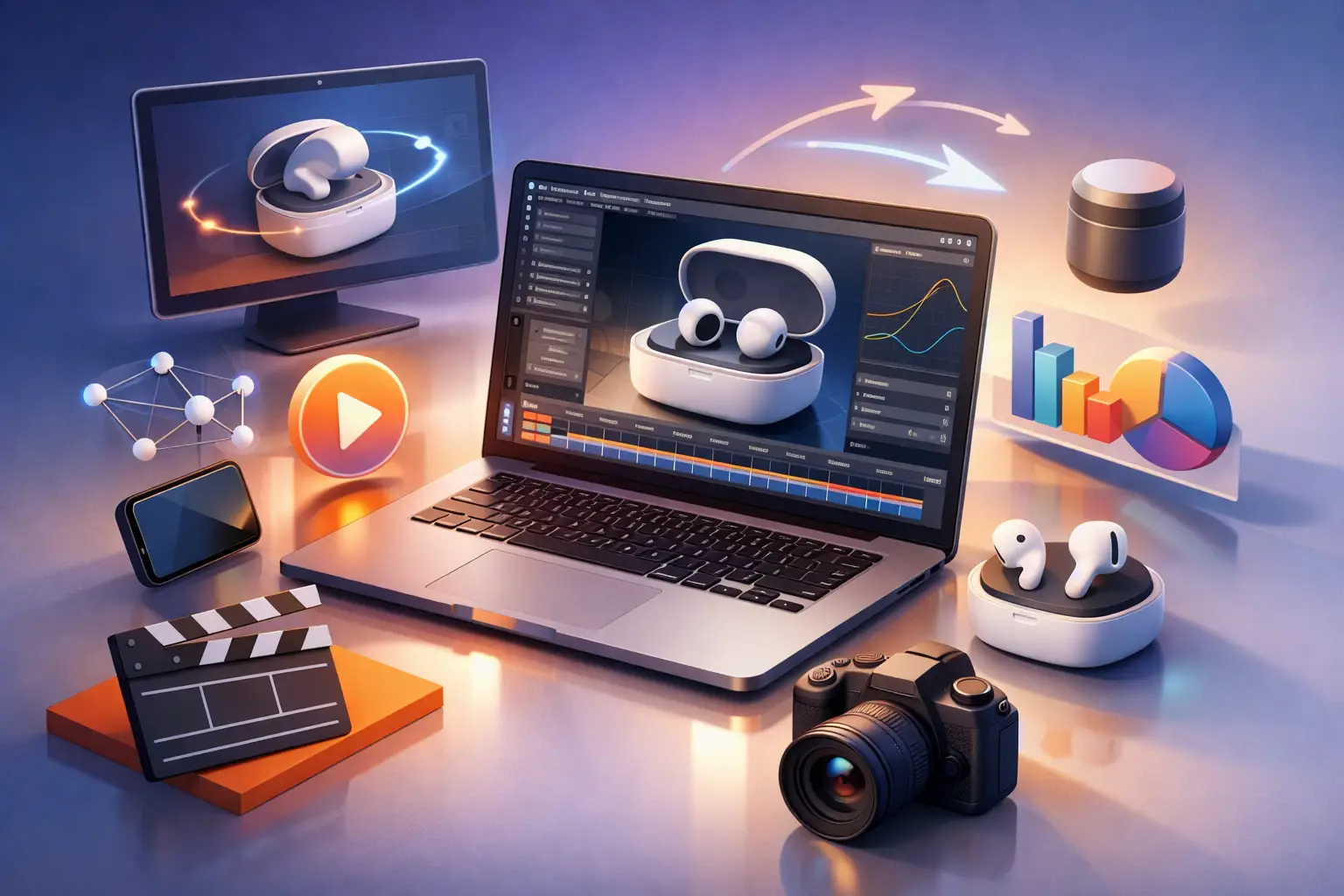
A precision-milled edge. The controlled bloom of a display. A microscopic component moving through a chassis in perfect time with a soundtrack. Technology product CGI animation turns details that are difficult to film, and often impossible to explain quickly, into a product story people can understand and remember.
For technology brands, the challenge is rarely a lack of innovation. It is translating engineering, performance and material quality into an immediate visual impression. A launch film may have seconds to establish why a device matters. Campaign content must retain its authority across cinema-scale screens, social formats, ecommerce, retail displays and sales presentations. The visual work has to make the product feel as considered as the technology within it.
Why technology products demand a different visual language
Technology sits at the meeting point of physical design and invisible capability. A camera sensor, a processor, a charging system or a connected service may be central to the proposition, yet none is naturally legible from a conventional product shot. Live action can establish tactility and human context, but it cannot always reveal what happens beneath an enclosure, inside an interface or across a connected ecosystem.
CGI gives a campaign the freedom to move between those worlds without breaking the visual logic. The camera can travel through a device, isolate a material transition, visualise data in a controlled way or place a product in an environment that would be impractical to build. This is not spectacle for its own sake. At its best, it gives complex information an elegant, instinctive form.
The standard is especially high because technology audiences recognise shortcuts. Reflections that do not behave like the real material, ports that are inaccurately positioned or motion that ignores the mechanics of a product can undermine the entire piece. Premium CGI depends on close observation, disciplined reference gathering and artists who understand that design intent lives in small decisions.
What exceptional technology product CGI animation achieves
The strongest work does more than rotate a device in a dark studio. It creates hierarchy. It tells the viewer where to look, what to feel and what to understand first.
A refined animation might begin with the silhouette and industrial design, before moving into a hero feature such as a lens system or adaptive display. It may then use an exploded view to explain the engineering, returning to an aspirational product shot at the point of resolution. The sequence feels effortless because every transition has a purpose: form introduces desire, function builds confidence and motion gives the proposition momentum.
This approach is valuable across consumer electronics, wearables, connected home products, telecoms equipment, mobility technology and enterprise hardware. The treatment changes with the audience. A consumer launch can be sensory and cinematic; a business-to-business film may need a clearer view of integration, reliability and infrastructure. Neither should sacrifice craft. Clarity is not the same as simplification.
Making the intangible visible
Many technology claims describe experiences rather than objects: faster response, lower latency, cleaner audio, safer data, smarter sensing. These benefits need interpretation. Abstract visual systems can make them tangible, but only when they are rooted in the product’s real function and brand character.
For example, a connectivity message may be expressed through precise light behaviour, spatial choreography or a transition between devices. A health technology story might require measured, clinically credible visualisation rather than generic particles and glowing interfaces. The art direction should never compete with the claim it is meant to clarify.
That is where creative judgement matters. A visual metaphor can elevate a message, while an overused one can make a category-leading product look interchangeable. Bespoke execution protects distinction.
Revealing design without losing desire
Technical cutaways are powerful, but too much explanation can strip a product of its mystique. The balance depends on the brief. If a component is the reason to believe, show it with accuracy and confidence. If the campaign is built around design leadership, let materials, proportion and atmosphere lead.
The most persuasive films move fluently between macro and micro. They give a viewer the pleasure of seeing a product as an object, then the satisfaction of understanding why it performs. That shift is difficult to achieve through product photography alone, particularly before physical samples are available.
The production decisions that shape quality
High-end CGI is won long before final rendering. A clear production framework gives artists room to pursue the detail that makes the work credible, while keeping approvals focused and the schedule controlled.
The brief should define the commercial role of the asset, not only its duration or aspect ratio. Is the animation introducing a new flagship product? Explaining a feature for retail teams? Supporting a keynote? Building anticipation before a launch? These uses affect pacing, framing, level of technical detail and the quantity of derivative content required.
Product reference is equally critical. CAD files are a valuable starting point, but they are not always a complete visual answer. Material samples, finish specifications, engineering guidance, photography, interface designs and physical prototypes can all be needed to recreate a product faithfully. A black finish may be anodised aluminium, coated glass, soft-touch polymer or a combination of surfaces that respond to light very differently.
Pre-production is where confidence is built
Storyboards and styleframes establish the visual argument before animation begins. They allow stakeholders to assess tone, lighting, composition and information hierarchy without debating a finished sequence that has already absorbed significant production time.
For a complex product, technical consultation should happen early too. This prevents attractive but inaccurate depictions of airflow, component placement, user interaction or system behaviour. The aim is not to make the creative process cumbersome. It is to ensure the final film can withstand scrutiny from both design teams and engineers.
Transparent communication is particularly valuable when several stakeholders are involved. A managed review structure keeps feedback consolidated, distinguishes preference from essential correction and protects the craft from late-stage contradiction. For global campaigns, it also helps teams align across markets, time zones and approval layers.
Build for a campaign, not a single delivery
A hero animation should be designed as the centrepiece of a content system. Product moments, feature sequences, loops, stills and alternate crops can be planned from the outset, preserving quality while extending the value of the production.
This does not mean every deliverable should be a reduced version of the master film. Vertical social content may need a stronger opening frame. Retail screens may call for legibility without sound. Ecommerce needs considered angles and clean detail. Planning these distinctions early avoids forcing one composition into formats it was never designed to serve.
When CGI is the right choice, and when it is not
CGI is not automatically the answer to every technology brief. If the story depends on a genuine human reaction, a live-action performance may carry more emotional weight. If a product is already available and the campaign needs documentary authenticity, photography or filmed footage may be the stronger lead medium.
Often, the most accomplished answer is a hybrid. Live action can ground a product in real life, while CGI takes the viewer inside the device or delivers transitions that could not be captured practically. The choice should follow the story, budget, timeline and state of product development rather than a preference for a particular technique.
CGI becomes especially effective when samples are incomplete, configurations are still evolving, multiple colourways must be shown, or the campaign needs visual control that a practical shoot cannot guarantee. It also offers continuity: a carefully built digital asset can support future launches, localisation and product updates, provided the original production is structured with that future use in mind.
Choosing the right creative partner
Technology work benefits from specialist talent, but specialism should not mean a fixed house style. A luxury wearable, an industrial sensor and a gaming peripheral demand different instincts in modelling, motion, lighting and visual storytelling. The right production partner matches the brief to artists with the appropriate sensibility, then maintains a single, accountable production process around them.
At Best of Breed, that combination of distinguished digital artists and considered production management is central to the approach. The objective is not simply a polished render. It is a bespoke visual asset that respects the product, advances the campaign and arrives with the level of control expected by ambitious brands and agencies.
A technology product earns attention through what it can do. CGI animation earns belief by showing that capability with precision, restraint and unmistakable visual authority. Begin with the one idea the audience must carry away, then give every frame a reason to make it clearer.