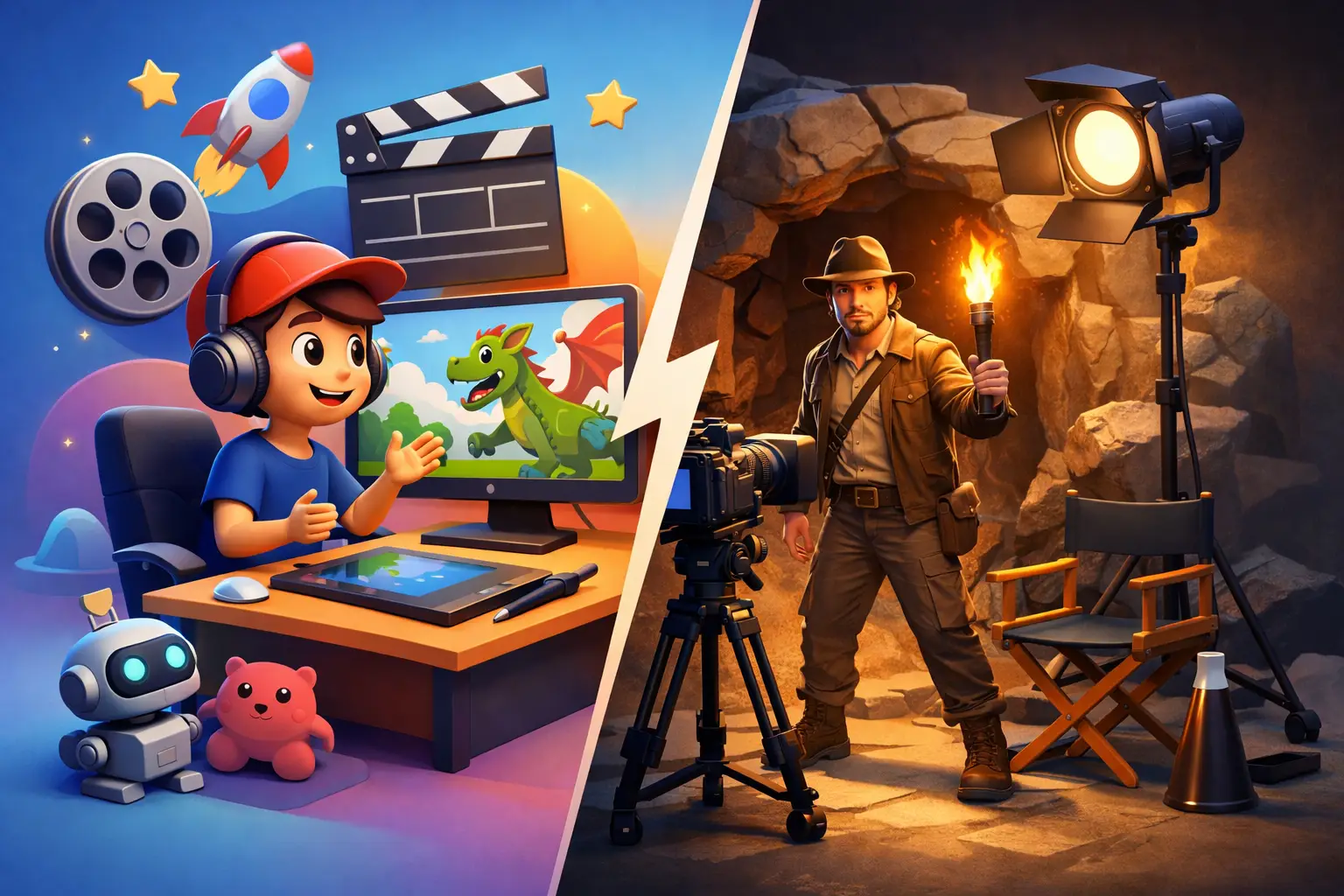
A perfectly chilled drink pours through a glass in zero gravity. A trainer flexes and reforms around an athlete’s foot. A microscopic active ingredient moves through the body with surgical clarity. These are not simply stylistic flourishes. They illustrate why the decision between animation versus live action is a strategic production choice, with direct consequences for what a brand can say, show and own.
For marketing teams, the question is rarely which medium is objectively better. It is whether the creative idea needs the physical credibility of a camera, the authored control of CGI, or a deliberate combination of both. The strongest work begins with that distinction before a location, casting brief or treatment is approved.
Animation versus live action: the real distinction
Live action records a performance, product or environment that exists in front of a lens. Its power lies in the evidence of the real: a human expression, a familiar street, the imperfections of natural light, the tactile behaviour of a material. When an audience needs to feel that something happened, rather than merely understand that it could happen, live action carries unusual authority.
Animation constructs the image. Whether the result is photoreal CGI, stylised character work, motion design or a hybrid composition, every element can be specified and refined. The director is not limited by weather, product availability, physics, scale or the practical constraints of a shoot. A camera can travel inside a device, across a garment’s fibres or through a product’s internal mechanism without asking an audience to suspend disbelief.
That difference changes the creative conversation. Live action asks, “What can we capture?” Animation asks, “What should exist?” For premium campaigns, that second question is often where differentiation begins.
When live action earns its place
Live action is particularly effective when human connection is the central message. A beauty brand showing a genuine morning ritual, a sports campaign built around athletic effort, or a food film where appetite depends on recognisable texture may benefit from the immediacy of a real set and real talent. Subtle gestures and unscripted moments can create an emotional texture that is difficult, and sometimes unnecessary, to reproduce digitally.
It can also be the right choice when cultural context matters. A location, community or event may carry meaning that should not be abstracted into a constructed world. Documentary-style brand films, testimonial content and founder stories rely on this sense of proximity. The audience is invited to trust what they are seeing because it appears observed rather than designed.
Yet live action is not automatically the more authentic option. A heavily retouched campaign, a product shown in a controlled studio set, or footage assembled from multiple takes is also a crafted representation. The difference is that many of the production decisions are made after filming, under the pressure of what was physically captured. Reshoots can be expensive. Seasonal light cannot be recreated on demand. Packaging updates can make an otherwise successful shot obsolete.
For a campaign with a fixed product, a straightforward narrative and a need for human warmth, those trade-offs may be entirely acceptable. For work that requires exacting product control across many markets, formats and future variants, they can become restrictive.
Where animation creates a commercial advantage
CGI animation gives brands control over the details that audiences may not consciously notice but always feel. Product proportions, material response, liquid behaviour, reflection, lighting, colour and camera movement can be developed to a precise creative standard. That level of authorship is invaluable when the product itself is the hero.
Consider packaging. A physical pack can be photographed beautifully, but it may not yet exist at the required stage of approval, or the finish may vary between prototypes. In CGI, the asset can be built from approved design data and adjusted as artwork, claims or formats evolve. One well-crafted master asset can support film, social cut-downs, stills, retail displays and market-specific versions without beginning again from a new shoot.
The value is equally clear in technology and pharmaceutical communications. A device’s internal architecture can be revealed without dismantling it. A complex biological process can be made intelligible without reducing it to generic visual shorthand. Animation can move from macro to micro scale in a single considered sequence, giving the viewer both spectacle and understanding.
It is also the natural medium for ideas that are physically impossible, unsafe or disproportionately costly to film. A car may transform into a sculptural object. Ingredients can become characters. A trainer can react to motion in real time. These are not constraints to work around. They are opportunities to give a brand a distinctive visual language.
Cost is a production question, not a medium verdict
The assumption that animation is expensive and live action is economical is too crude to guide a serious campaign. Both can be premium investments, and both can become inefficient when the scope is unclear.
Live action costs can rise quickly through location fees, travel, crew, talent, set builds, practical effects, product handling, weather cover and post-production. A campaign that requires multiple markets, product versions or different aspect ratios may involve a complex combination of reshoots and retouching. The apparent simplicity of filming can disappear once the operational demands are properly mapped.
CGI requires an upfront commitment to modelling, look development, animation and rendering. High-end work is not a shortcut, nor should it look like one. It depends on distinguished artists who understand form, composition, light and movement as deeply as the technology behind them. But the investment can become more efficient when a project needs multiple assets, precise adaptations or a longer working life.
The most useful budgeting question is not, “Which is cheaper?” It is, “What must this campaign produce over its lifetime?” A single hero film has different economics from a content system expected to supply global launch assets, product updates, retail imagery and paid social for two years.
The hybrid option is often the most persuasive
The choice is not always binary. Some of the most convincing commercial work combines live action’s human texture with CGI’s ability to control the impossible.
A real athlete can anchor a performance campaign while CGI enhances apparel behaviour, visualises energy or introduces an otherworldly environment. A food shoot can retain the sensory appeal of practical styling while CGI delivers impossible camera moves, pristine pack presentation or floating ingredient sequences. In beauty, live-action skin and hair can sit alongside digitally perfected product moments that would be impractical to capture repeatedly.
The challenge is integration. If CGI is treated as an afterthought, the lighting, lensing, perspective and material qualities can feel disconnected from the photographed world. The hybrid approach must be planned from the outset, with shared visual references, technical capture requirements and a clear understanding of where reality ends and construction begins.
This is where experienced production management matters. A specialist team can bring the right artistic discipline to each element while keeping the client experience clear: one brief, one visual standard, one accountable route from concept to final delivery.
How to choose the right production route
Start with the role the image must play. If the work needs to establish emotional credibility through faces, place or lived experience, live action may lead. If it must explain, transform, magnify or perfect the product, animation is likely to offer greater range. If both are true, develop the idea as a hybrid rather than forcing one medium to imitate the other.
Next, examine the product’s readiness and likely changes. Is the final packaging approved? Are there multiple SKUs, languages or technical configurations? Will the campaign need to be refreshed after launch? CGI can turn this complexity into a flexible asset library, provided the original build is planned with reuse in mind.
Then consider the brand’s visual ambition. A familiar category does not need familiar imagery. When every competitor is filming the same gestures, surfaces and studio scenarios, a bespoke animated world can create the memorability that media spend alone cannot buy. Conversely, a highly stylised treatment can be the wrong answer when the audience is looking for evidence, reassurance or an unvarnished human story.
Finally, judge the production partner by more than a reel. The work should demonstrate artistic mastery, but the process must also withstand scrutiny. Ask how visual development will be approved, how changes will be managed, what technical assets will be delivered and how consistency will be protected across formats. Best of Breed approaches CGI production as both a creative craft and a managed service, connecting specialist talent to the precise needs of a brief.
The most effective choice is the one that makes the brand’s promise feel inevitable on screen. Sometimes that promise needs the grain of real life. Sometimes it needs a world that only artists and technology can construct. The brief should decide, and the execution should make the decision look effortless.