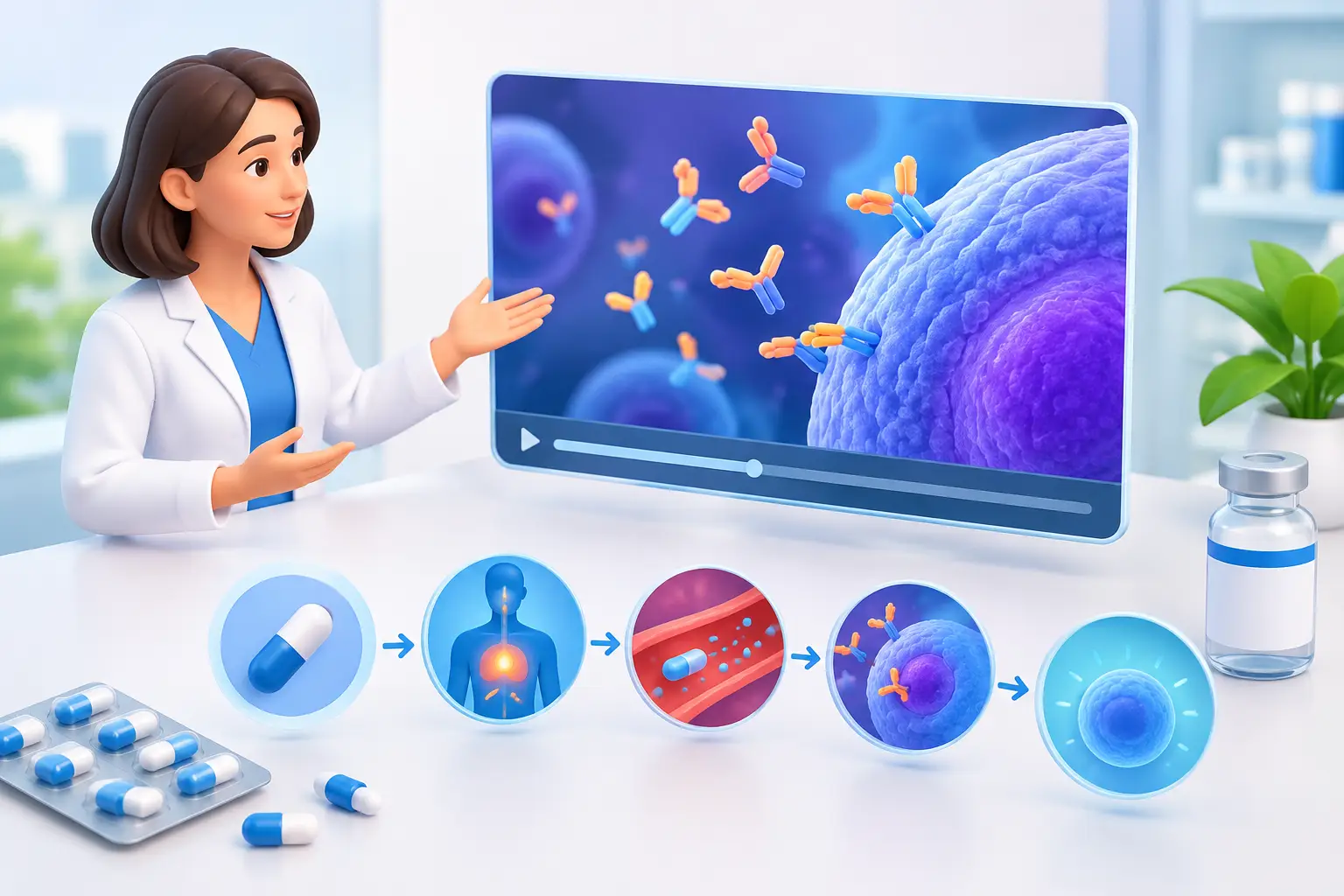
A strong pharma explainer animation example does more than make a molecular process look impressive. It gives a clinical, commercial and regulatory story a clear visual structure – without reducing the science to decoration. For brand teams and agencies, that distinction is decisive. The animation must hold the attention of a busy audience while preserving the precision that earns the confidence of healthcare professionals, investors and internal stakeholders.
The most effective work treats CGI as a communication discipline. Every camera movement, cellular environment and graphic transition should clarify a specific point: how a disease pathway functions, where a therapy acts, what differentiates a delivery mechanism, or why a dataset matters. When the creative logic is as rigorous as the scientific logic, the result feels credible as well as visually distinctive.
What a pharma explainer animation example should achieve
Pharmaceutical communication often asks audiences to absorb several layers of information at once. There may be a disease burden to establish, a biological mechanism to explain, a treatment pathway to introduce and evidence to present. A conventional sequence of slides can communicate the facts, but rarely builds understanding with the same speed or emotional focus as carefully directed animation.
A well-made explainer creates hierarchy. It decides what the viewer needs to grasp immediately, what can be inferred through imagery, and what deserves a moment of close attention. That may mean beginning at the human scale with a patient-relevant condition, moving into an anatomical system, then travelling through tissue and into a cellular or molecular environment. The movement is not there for spectacle. It makes scale, causality and therapeutic intent legible.
This matters particularly where the subject is unfamiliar or visually abstract. Receptor binding, RNA delivery, immune modulation and targeted degradation cannot be filmed in a literal sense. CGI gives the production team the freedom to create an accurate visual model, isolate the relevant action and remove distracting biological noise. Yet freedom requires restraint. If every particle glows, every surface pulses and every transition accelerates, the work becomes a generic scientific fantasy rather than a credible explanation.
A model structure for pharmaceutical storytelling
Consider a hypothetical animation for a therapy designed to interrupt an overactive inflammatory signalling pathway. The strongest version would not open with a floating molecule against a black background. It would begin by defining the biological problem: an elevated inflammatory response that continues to signal after it should resolve. This gives the molecular sequence a reason to exist.
The film could then move from the affected tissue to an individual immune cell, showing the relevant receptor and signalling cascade with deliberately selective detail. Rather than attempting to represent every interaction, the animation would focus on the few events essential to the claim. A colour system might distinguish the inflammatory signal, the therapeutic agent and the downstream response, carried consistently from microscopic scenes into data graphics and end frames.
At the point of intervention, the therapeutic mechanism should be shown with calm precision. Binding, blocking or modulation needs to be visually unambiguous, with timing that allows the audience to understand the relationship between cause and effect. The following scene can show the intended impact on the pathway, but it should not imply clinical outcomes beyond the approved evidence. This is where close collaboration between creative, medical, legal and regulatory teams protects both accuracy and brand value.
The final section may shift to the real-world proposition: an approved indication, administration format, trial endpoint or appropriate branded message. It does not need to repeat the science. It should give the scientific story a commercial landing point, supported by considered typography, data visualisation and a visual identity that feels integral rather than applied at the end.
The science needs a visual point of view
Scientific accuracy does not require visual literalism. Molecular environments are interpreted models, and a production should acknowledge that through careful artistic choices. The question is not whether a cell membrane is rendered with every possible irregularity. The question is whether the selected level of detail helps the viewer understand the mechanism without introducing ambiguity.
That is why the visual language must be established early. Photorealistic CGI can lend weight to a high-stakes mechanism or premium therapeutic platform. Stylised CGI may be more effective when the audience needs to follow a complex sequence quickly across a short runtime. A hybrid approach can pair highly crafted biological imagery with restrained motion graphics for statistics, study design or product information.
There is no universally correct style. A launch film for specialist clinicians, an internal pipeline presentation and an unbranded disease-awareness campaign have different needs. What they share is the requirement for an intentional system of scale, colour, lighting, pacing and labelling.
Where quality becomes commercially visible
Pharma audiences are accustomed to polished visual material. Quality alone will not differentiate a campaign, but weak production values can quickly undermine its authority. Anatomical forms that feel generic, inconsistent material rendering, unreadable data screens or motion without narrative purpose can make even sound content appear less considered.
High-end CGI earns its place when it makes the invisible tangible and the complex coherent. A precisely built bloodstream, a convincing tissue cross-section or a refined molecular sequence gives a therapy’s scientific proposition a distinctive visual asset. That asset can then extend beyond one film into congress screens, sales-aid presentations, paid media edits, social cut-downs and investor communications, provided the original production has been planned for adaptation.
This is also where bespoke execution matters. Stock-like science imagery may offer speed, but it can rarely carry a brand’s particular mechanism, formulation or therapeutic territory with conviction. Custom asset creation allows the work to reflect the actual scientific narrative while creating recognisable campaign equity. The trade-off is investment and lead time, which makes early strategic alignment essential.
The production decisions that protect accuracy
The best pharmaceutical animation is shaped well before rendering begins. A clear brief should identify the audience, the communication objective, the approved claims, the evidence hierarchy, required terminology and anticipated distribution channels. A two-minute congress film and a 20-second social asset may share a central mechanism, but they cannot carry the same density of information.
A disciplined pre-production phase usually resolves the questions that are most expensive to solve late: Which scientific moments require expert review? What must be shown versus stated on screen? Which claims require qualification? Does the audience need a detailed molecular explanation or only enough context to understand differentiation?
Storyboards are particularly valuable because they expose gaps in logic before the creative team commits to complex 3D work. They also give medical and regulatory reviewers something concrete to assess. A production partner should make this stage transparent, translating feedback into clear visual decisions rather than allowing rounds of comments to dilute the narrative.
At Best of Breed, that process can bring distinguished CGI artists and specialist production oversight around the requirements of a particular campaign. The advantage is not simply access to visual craft. It is the ability to match the subject with artists whose capabilities suit the brief, then manage the work with the clarity expected in high-stakes commercial production.
Common mistakes in pharma explainers
The most common mistake is trying to show everything. A pathway may contain dozens of relevant components, but an explainer only needs the elements that support its communication objective. More detail is not automatically more authoritative; unprioritised detail can make the central mechanism harder to retain.
Another is separating creative ambition from compliance until late in the process. When medical or legal review is treated as a final obstacle, teams often face rushed revisions that compromise both clarity and finish. Bringing reviewers into the structure and animatic stages produces a more controlled result.
Finally, avoid treating the end card as the only branded moment. Brand character can be present throughout the film in the visual system, the rhythm of the edit, the discipline of the typography and the material quality of the CGI. It should feel authored, not overlaid.
A pharmaceutical animation is at its most valuable when viewers leave with one precise idea they can explain to someone else. Build the film around that idea, and the science, artistry and production craft will have a clear job to do.