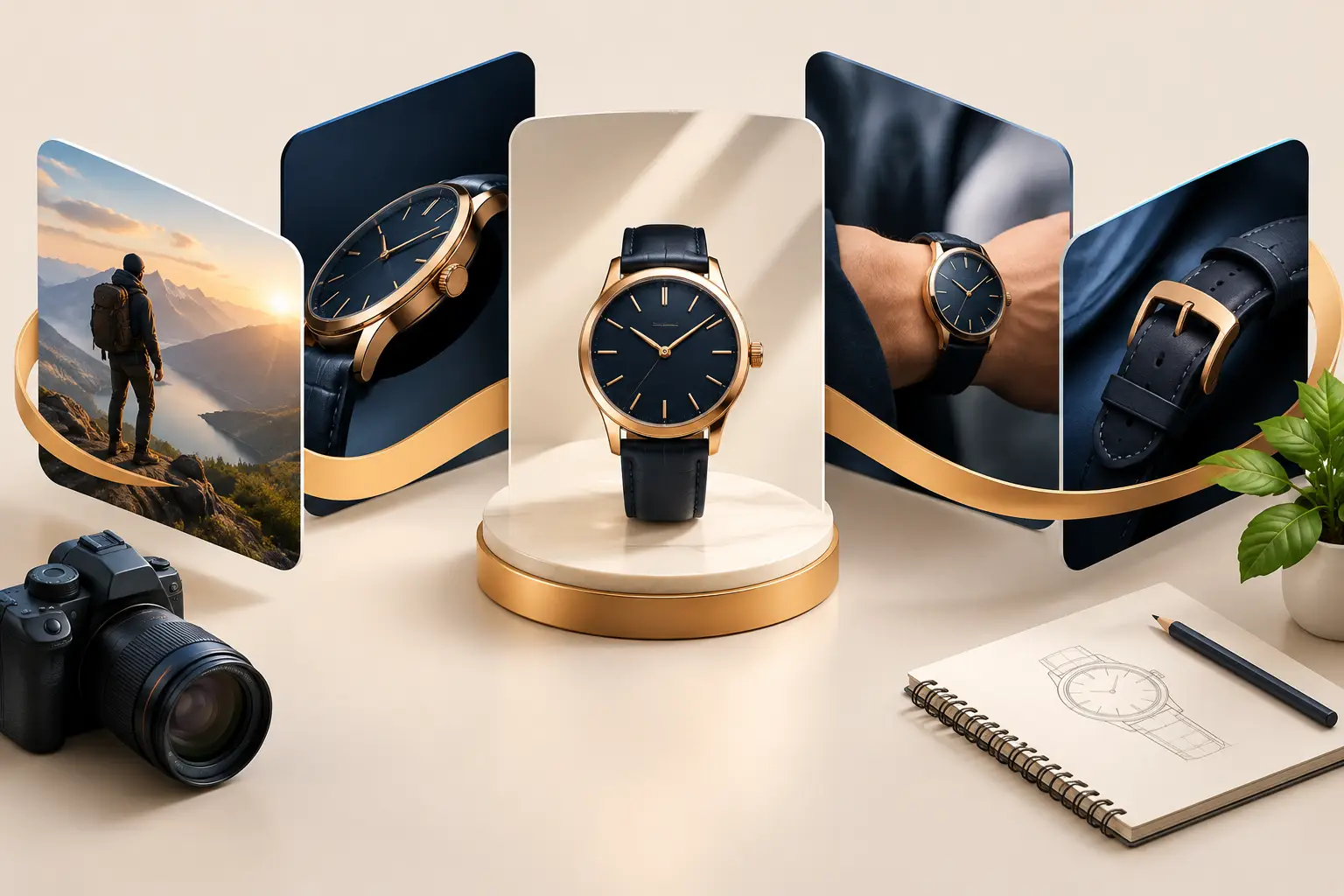
A product image has only a moment to earn attention, but the strongest work continues to communicate after the first glance. It reveals why an object matters, how it belongs in a customer’s life and what level of care sits behind it. This product visual storytelling guide is for brand teams that need more than polished packshots: they need a visual idea with the authority to carry a campaign.
For premium brands, storytelling is not decoration applied after the product is made. It is the discipline of making product value visible. In CGI, that can mean placing an impossible cutaway inside a technology launch, giving food texture a cinematic presence, or turning a pharmaceutical mechanism into something lucid and compelling. The objective is not to make the product look busy. It is to make its distinction unmistakable.
Start with the product tension, not the asset list
Campaign briefs often begin with deliverables: hero film, social cut-downs, e-commerce stills, out-of-home formats and retail screens. Those requirements matter, but they cannot supply the central idea. A story starts with the tension the product resolves or the perception it needs to change.
A sportswear brand may need to show speed without relying on familiar motion streaks. A beverage launch may need to make refreshment feel physical before a consumer has tasted it. A technology product may need to communicate sophisticated engineering without becoming cold or impenetrable. Each challenge calls for a different visual language.
The most useful question is simple: what should the audience understand or feel that they would not get from a conventional product photograph? The answer gives the creative team a proper point of view. It also protects the work from becoming a collection of attractive but disconnected frames.
A premium visual story usually holds one dominant proposition. It may be precision, transformation, indulgence, protection, lightness or performance. Secondary messages can support it, but they should not compete for attention. When every product benefit is given equal visual weight, the result often explains too much and says too little.
Product visual storytelling guide: build a visual grammar
Once the core proposition is clear, translate it into a visual grammar that can be recognised across every asset. This is where art direction moves beyond a moodboard. Colour, material, composition, movement, lighting and scale should all reinforce the same thought.
Give the product a role
The product can be the hero, the catalyst or the proof. A hero product commands the frame through silhouette, finish and considered lighting. A catalyst changes its environment: a skincare formula may turn liquid into an abstract expression of efficacy, while a headphone transforms silence into visible space. A proof-led product exposes the feature that validates its promise, such as an engineered internal structure or a precisely rendered ingredient.
This choice shapes everything that follows. If the product is a hero, the framing should preserve its presence. If it is the catalyst, the surrounding world needs to react credibly. If it is the proof, visual clarity takes priority over spectacle.
Treat materials as meaning
In high-end CGI, material realism is not merely a technical benchmark. It is a storytelling tool. Condensation can suggest immediate refreshment. A controlled powder plume can convey energy or softness. The way fabric catches light can express engineered performance or quiet luxury.
The trade-off is restraint. Excessive reflections, particles or simulations can obscure the object they are meant to elevate. Details should earn their place by reinforcing the product’s character. Distinguished craft is often felt in the decisions the viewer barely notices: the viscosity of a liquid, the edge softness of a shadow, the believable pressure of a hand against a surface.
Use movement with purpose
Animation gives product stories an additional advantage: time. It can reveal assembly, demonstrate an invisible process or build anticipation before the reveal. Yet movement should have a reason beyond keeping the frame active.
A slow, exact camera move may be right for a luxury device where control and finish are central. Dynamic transitions may better suit apparel, sport or consumer technology. The right pace depends on the audience, placement and message. A six-second social asset demands a different narrative economy from a 30-second launch film.
Make CGI serve the idea, not the other way round
CGI offers remarkable freedom, particularly where live-action production becomes restrictive, expensive or physically impossible. Products can be visualised before manufacturing is complete. Environments can be shaped around the brand rather than sourced from the real world. Complex scientific, technical or microscopic stories can be made accessible without sacrificing visual ambition.
That freedom requires judgement. The audience may not know how an image was produced, but they recognise when a visual world lacks logic. Weight, gravity, reflections, texture and motion need to feel considered, even when the scene is deliberately surreal. Credibility gives imagination its licence.
The most effective CGI work occupies a precise space between reality and invention. It is grounded enough for the product to feel desirable and trustworthy, yet heightened enough to create a world no standard shoot could deliver. This balance matters especially for packaging, food and beauty, where the viewer is highly sensitive to finish, freshness and material detail.
For technically complex sectors, CGI also makes abstraction useful. Pharmaceutical and technology brands frequently need to communicate mechanisms that cannot be filmed. The solution is not automatically a literal 3D diagram. An award-winning visual treatment can simplify information while preserving accuracy, using scale, translucency, motion and composition to make a difficult idea instantly legible.
Design for a campaign system, not one perfect frame
A hero image can establish the visual territory, but commercial storytelling has to perform across formats. The central concept should survive a portrait crop, a wide digital display, a motion loop, a retailer listing and a close product detail. Planning this early prevents a common production problem: adapting a beautiful master asset until its original logic disappears.
Create a hierarchy of moments. The first should attract attention immediately. The second should reveal the product or its key benefit. The third should reward closer viewing with texture, craft or a detail of performance. This approach gives a campaign depth without demanding that every placement communicate everything.
Consistency does not mean repetition. A campaign can shift camera angle, setting or pace while retaining its identity through a stable visual grammar. The same light quality, material palette or transformational gesture can hold a suite together. This is especially valuable when a global launch needs local formats without losing its premium standard.
Production discipline protects creative ambition
The finest visual idea still depends on how it is produced. High-end CGI requires an exact brief, clear decision-making and a process that allows specialists to contribute at the right stage. A distinctive style may call for illustration-led design, product visualisation, character animation, fluid simulation or compositing expertise. No single creative approach is right for every brief.
That is why the production partner matters as much as the technology. The right team brings together artists whose specialist strengths suit the story, then manages the work with transparent communication from concept through to final delivery. At Best of Breed, this combines access to distinguished digital artists with the structure needed to maintain quality across complex commercial requirements.
Before production begins, align on what must be exact and where the creative team has room to explore. Product dimensions, packaging artwork, claims, regulatory details and brand colour specifications may be non-negotiable. Atmosphere, transitions, environments and visual metaphors may be the areas where a stronger creative solution emerges. Clear boundaries make the process faster, not narrower.
Measure the right response
Product visual storytelling should be assessed against more than approval in a presentation room. Ask whether the work makes the product easier to recognise, the proposition easier to recall and the desired brand perception more credible. For performance-led campaigns, consider whether the key feature is understood without added explanation. For premium launches, consider whether the visual treatment justifies the intended positioning.
Attention metrics can be useful, but they are not the full measure of quality. A highly arresting image that confuses the product is a weak commercial asset. Equally, an entirely clear image that looks interchangeable may not create enough desire to move the audience. The best work resolves both demands: it is immediate, ownable and purposeful.
Give the product a world that only it could inhabit. When the idea, craft and production process are aligned, every frame can do more than display an object – it can make the audience feel why that object deserves to be chosen.