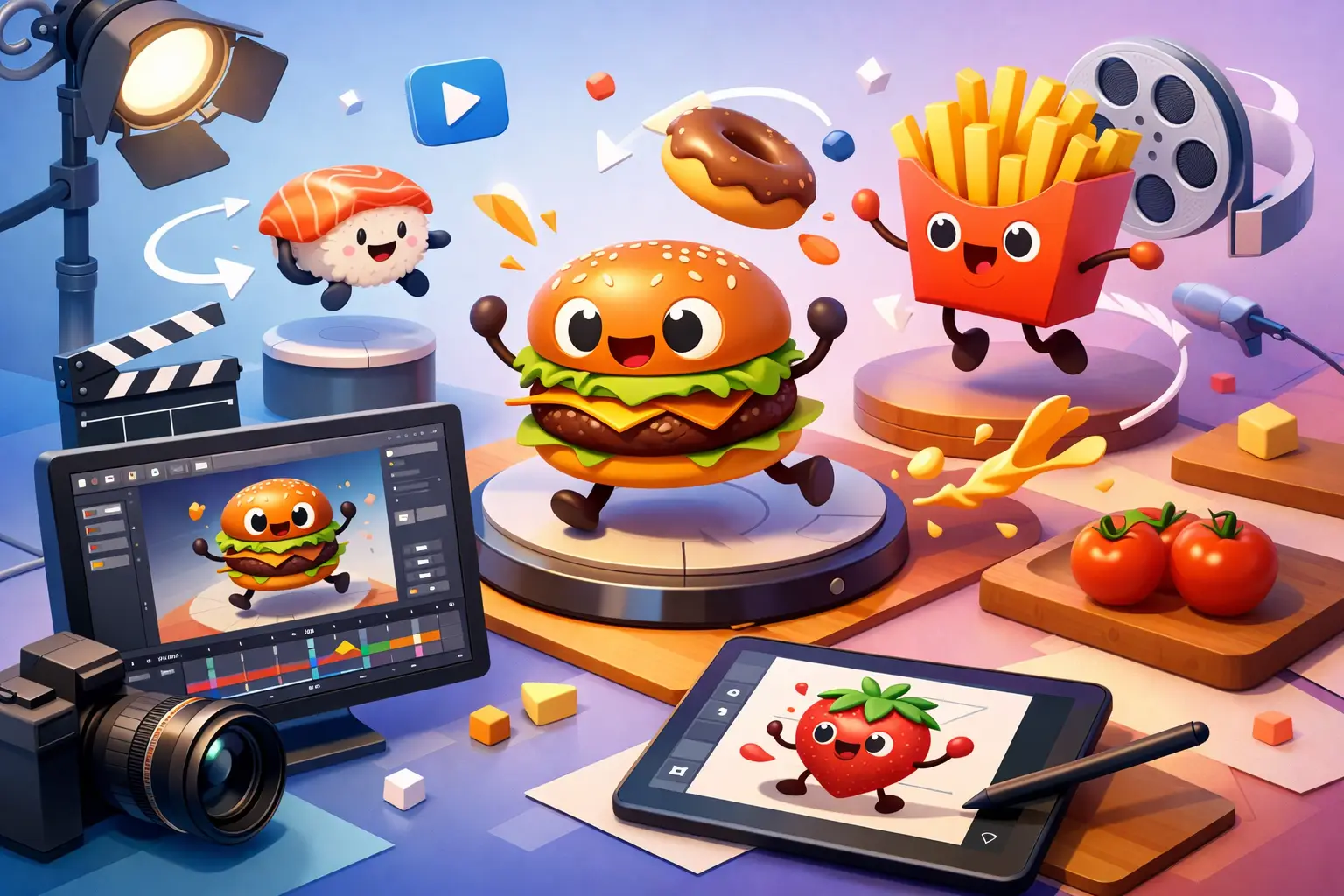
A chocolate square that breaks with the wrong amount of resistance can make an entire campaign feel synthetic. A strawberry that lands too lightly loses its sense of weight. Knowing how to animate food is less about making ingredients move and more about directing appetite, anticipation and material truth at 25 frames per second.
For premium food advertising, animation has to make the viewer believe in a sensation they cannot physically experience: the snap of a biscuit, the gloss of a sauce, the lift of a freshly baked crumb. CGI gives creative teams extraordinary control over that experience, but control only creates value when it is guided by close observation, artistic judgement and a clear campaign idea.
How to Animate Food with Conviction
The first decision is not software, simulation settings or render resolution. It is the desired response. Should the audience crave the product, understand its ingredients, recognise its indulgence or appreciate its precision? A fast-moving product reveal and a slow, cinematic pour can feature the same bottle, yet communicate entirely different brand values.
Food animation is particularly unforgiving because audiences know food intimately. They have watched cream fold, oil catch light and fizzy drinks settle thousands of times. Even when they cannot explain why a shot is wrong, they can sense when movement lacks the subtle behaviour of the real world. This is why reference is foundational. Distinguished CGI artists examine footage frame by frame, looking beyond the obvious action to study inertia, surface tension, compression, fracture, splashes and the small delays that make motion credible.
Reference should inform rather than restrict the work. A commercial animation may intensify the height of a splash, slow the falling crumbs or make a liquid ribbon hold its shape for longer than physics permits. That is often the point. Food CGI operates in the space between realism and idealisation: real enough to trigger appetite, composed enough to express the brand at its best.
Start with the Hero Moment
Every successful food sequence has a hero moment. It may be the first cut into a dessert, a wave of milk around cereal, a burger assembling in mid-air or the instant seasoning settles across a crisp. Establish that moment before building secondary action around it.
This principle keeps production focused. Without it, a sequence can accumulate motion that is technically impressive but visually unfocused. Multiple ingredients flying through frame, energetic camera moves and elaborate simulations can compete for attention rather than build desire. Premium animation is often defined by restraint. One exquisitely timed action, photographed from the correct angle, has more impact than five competing effects.
The hero moment also determines the camera language. A macro shot can make the architecture of a pastry feel monumental, while a wider, elevated view may be essential for a dynamic ingredient composition. Camera movement should amplify the product’s form and behaviour. It should not be used merely because a virtual camera can travel anywhere.
Timing Is the Difference Between Motion and Appetite
Food has rhythm. Dense objects generally need a convincing sense of mass before they stop. Crisps, herbs and crumbs need irregularity. Liquids need a readable beginning, middle and end: a build-up, a release, then the small residual movements that prevent a pour or splash from feeling abruptly switched off.
Slow motion is valuable because it gives viewers time to read texture and transformation. However, slowing every action can flatten the energy of a campaign. The most effective films vary pace deliberately. A sharp impact can be followed by a lingering close-up. A burst of ingredient motion may resolve into stillness around the pack shot. This contrast creates emphasis and gives the audience a moment to register the product.
There is also a practical consideration. Animation intended for social placements may need to establish product recognition in the first second or two, while a cinema or broadcast execution can allow more time for atmosphere. The same creative idea should therefore be adapted, not simply cropped, across formats.
Build Texture Before You Simulate
A technically accurate fluid simulation will not rescue an unconvincing material. Before animation begins, the food needs to look appetising in stillness. That means developing its surface qualities with care: the fine pores of bread, the slight translucency of fruit flesh, a glaze’s uneven reflections, the powdery edge of flour or the micro-scratches on a piece of packaging.
Texture work matters because movement reveals material. As a doughnut rotates, light describes its coating. As a sauce falls, its thickness becomes visible in the way it stretches and gathers. As chocolate fractures, the interior and exterior must respond differently. A single generic shader may be efficient, but it rarely carries the richness required for a high-end food campaign.
Lighting should be developed alongside materials, not added at the end. Food lighting is rarely about uniform visibility. It is about selective definition: a controlled highlight that conveys freshness, a soft shadow that gives volume, a rim light that separates steam from the background. The right lighting can make a familiar product feel tactile and elevated without sacrificing its recognisability.
Use Physics, Then Art Direct It
Physics-based simulation is essential for many food actions, including pours, splashes, falling ingredients, melting, breakage and soft-body deformation. Yet raw simulation is only a starting point. Real-world physics can be messy, chaotic and visually indecisive. Advertising requires a more deliberate result.
Artists often guide or layer simulations to create a readable silhouette, protect the hero product and maintain a pleasing composition. A splash may be shaped so it frames a bottle rather than obscures it. A cluster of berries may be directed to land with spontaneous-looking variety while avoiding awkward overlaps. The result should feel natural, even when every element has been carefully controlled.
The trade-off is time. Highly art-directed liquid and particulate work needs iteration, especially at close range. If the campaign relies on a single spectacular fluid shot, invest in testing early. If food is seen only briefly or at distance, the production may achieve more by concentrating effort on lighting, camera choreography and the final pack shot.
Detail at the Right Viewing Distance
Not every asset needs the same level of complexity. A macro beauty shot of a biscuit demands detailed geometry, refined displacement and close attention to breakage. The same biscuit in the background of a wider scene can be built more efficiently. This is not a compromise in quality. It is intelligent allocation of production effort.
The same applies to movement. A foreground strawberry may require bespoke animation and secondary deformation; distant ingredients can rely on simpler variation. Planning shots according to visibility helps maintain unmatched quality where the audience will actually see it, while protecting time for compositing, finishing and approvals.
Plan Food Animation as a Production System
The strongest CGI food films are won in pre-production. A clear brief aligns the creative ambition with practical deliverables, from aspect ratios and shot lengths to pack accuracy and regional claims. It also gives the artist team room to solve the right problem rather than revisit fundamental decisions late in the schedule.
For complex productions, the brief should establish at least five areas:
- the campaign objective and emotional response required from the viewer;
- product truths that must remain exact, including packaging, ingredients and brand cues;
- the hero actions and reference for each physical behaviour;
- the final channels, durations, crops and technical delivery requirements; and
- the approval process, including who signs off on brand, food styling and legal details.
A strong animatic is equally valuable. It tests pacing, composition and narrative before the team commits to detailed simulation and rendering. At this stage, imperfect stand-in assets are useful because the conversation is about whether the film works, not whether a highlight is polished. Once the timing is approved, the work can progress with greater confidence.
Transparent communication matters throughout. Food animation combines specialist disciplines – modelling, look development, simulation, animation, lighting, rendering and compositing – and each affects the others. A managed CGI production process keeps those decisions visible, protecting both the creative standard and the delivery schedule.
Do Not Let CGI Look Too Perfect
The temptation in digital food work is to remove every imperfection. But perfectly identical sesame seeds, faultless icing and symmetrical crumb distribution can make a product feel manufactured in the wrong way. The goal is controlled imperfection: enough natural variation to create credibility, with enough art direction to retain appetite appeal.
This balance depends on the category. Confectionery may call for jewel-like precision and rich specular detail. Fresh produce benefits from small irregularities, subtle blemishes and moisture variation. A premium beverage may need immaculate glass and graphic liquid forms, while still retaining tiny bubbles, condensation trails and believable refraction. There is no universal realism setting. The visual language must serve the product, audience and positioning.
When food animation is treated as performance rather than decoration, it can carry a campaign’s most persuasive message without a word. Give the product weight, texture, rhythm and a clear reason to be watched, and the final frame will do more than look beautiful – it will make the audience want the next bite.